

Source for clip: http://youtu.be/zL1_twK2NDc
Tag: gif


William Wegman’s first animated gif. (via this isn’t happiness)
Awww…only just discovered this. I promised myself no twee gifs… I am sorry, cannot resist this. Can you?


What lies behind the mask?
Source and more faces: http://karialtmann.com/work/2008/dreamcaptchas/dreamcaptchas02.html


The importance of history – advise to new students
One of the things I most value about being part of the DS106 community is that it makes come alive years of theory and research on the creative process.
On this post I want to talk about Bagman, a character that is part of the DS106 oral tradition and how it relates to a systemic theory of creativity.
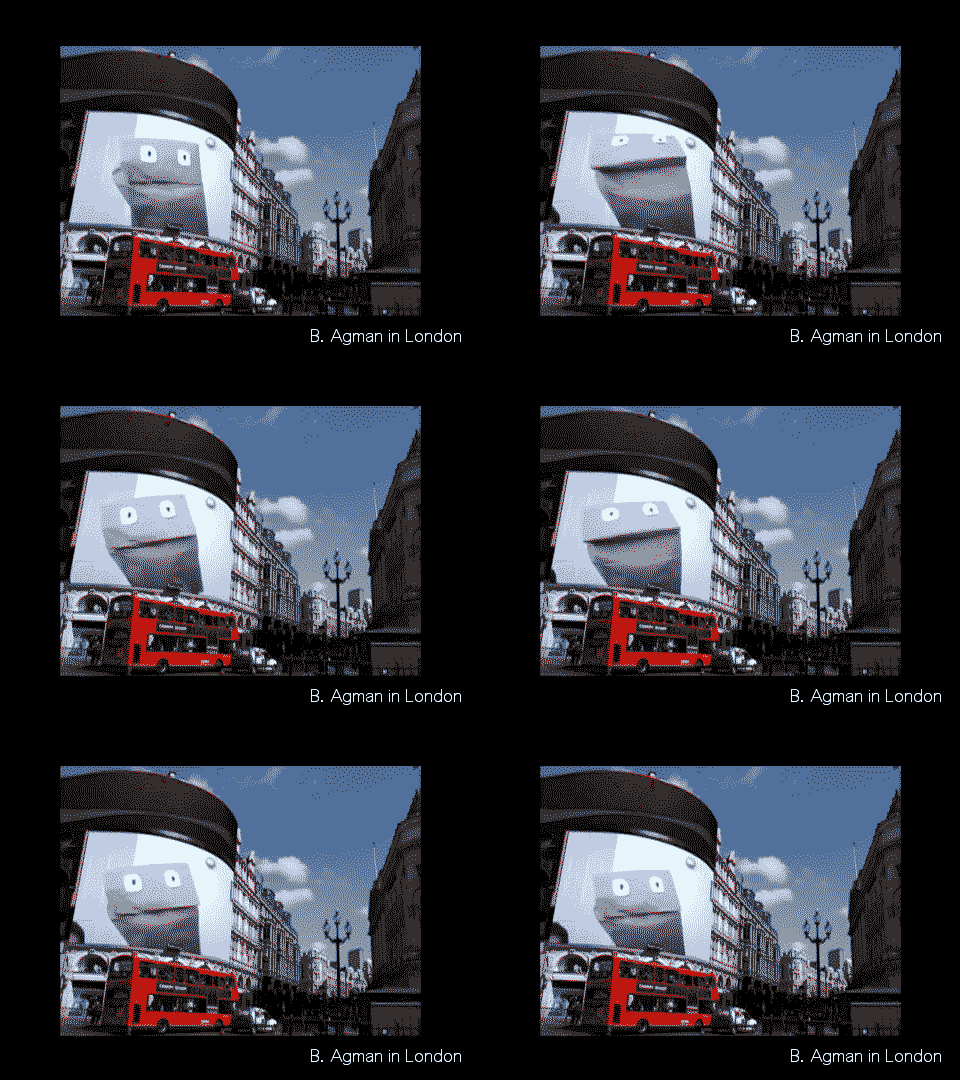
I started the week looking for a photo of ‘the little paper bag character’ I had seen on Twitter some time ago. I thought it was created by Martha Burtis but soon found out that it was Brian Short’s original idea, that it was called Bagman and that he had ran for president in the past with a comprehensive campaign being staged by past DS106 participants. He has become an assignment on the DS106 bank.
His most recent appearance was to claim his own domain at UMW, a trailer well worth watching. Search for him on the google and there are pages of fun art to listen to and watch, all to do with this little paper bag creation.
Why bother writing about him? Other than the obvious prima facie reason that he is awesome, there are those out there who need a rationale for having fun, if that is not too much of an oxymoron. Sheep! I needed a rationale to join this cult #4life not too long ago.
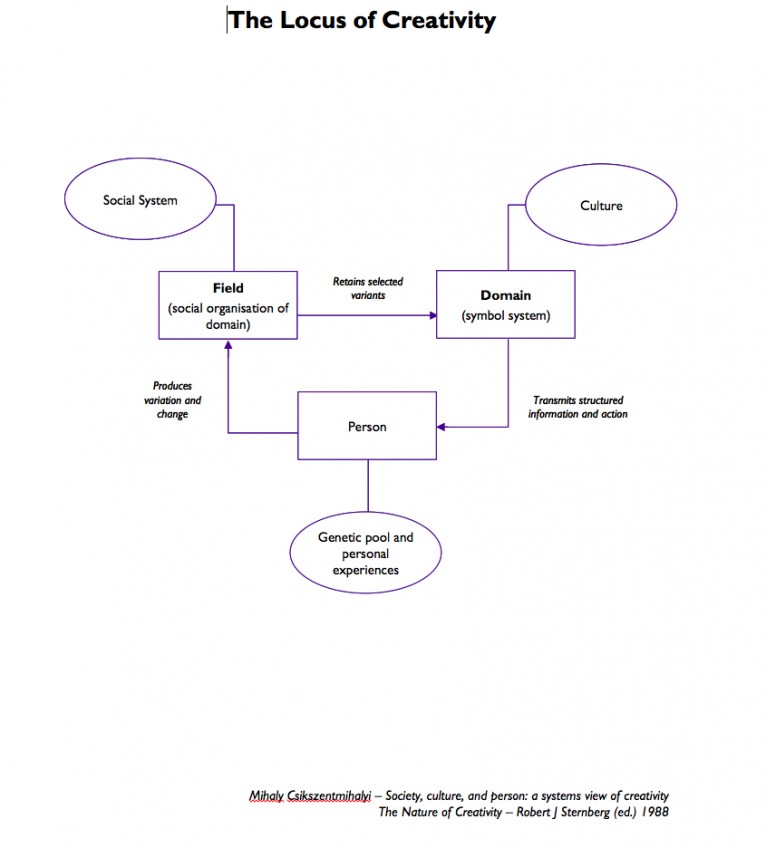
So let me be serious for a minute and bring to bear my academic expertise as the DS106 Shrink to the important subject that is Bagman or B. Agman as I believe he is known on Linkedin. The dry and boring diagram on photo set above, explain systemic creativity. I put it here for completeness but will only focus on what is relevant to this story.
As I was digging into the history of DS106 through finding out about this little character, I had a lived experience of what Csikszentmihalyi (the guy responsible for boring diagram) means when he says that we need to ask where is creativity? Rather than, What is creativity?
In psychology often the focus is on the person and how to develop individual creativity. Until I came across this model I used to focus all my workshops on individual creativity too. But the individual is not an island and in order for creative output to obtain, we need to look beyond the ‘I’. The individual belongs to a field or craft. In that field there are colleagues, journals and review processes that determine what becomes part of the domain of that field. The acceptance of a given output by the field into the domain determines what future students learn as the symbol system for that field that they can then deviate from – the symbols they will manipulate to become creators. A key thing the theory proposes and one that is often forgotten by those who want to encourage creativity is the need of years of training and practicing to learn that symbol system – in other words you will not become Einstein without learning physics.
This is similar to what Ira Glass says about practicing your craft. You will suck for a long time as you learn your craft, what you do will not be accepted in the field and even if your taste is impeccable all the way through your output will not match your taste. Do read Alan Levine’s latest post to understand more about this and learn a lot about what teaching means within our little DS106 community.
What does all this have to do with Bagman?
I have always struggled to explain this theory to my students. It seems self evident to me, but not often to others on first seeing it. I can now explain it with Bagman. Tracking his story this morning taught me a little more about the people who ‘are’ DS106 today, this will help me join the conversation. It is always tough to come into a party where you don’t know anyone; knowing their war stories, their recurrent jokes and developing an ability to contribute to their interactional currency will help you join in. In some ways, all we have online is this narrative history to establish relationships within an existing social system.
If you are coming in new to DS106 it would pay you to study it narrative history or as I think of it, its oral tradition.
The open web is a great repository of this tradition as many students before you have engaged with the course and produced creative outputs for it. DS106 has a symbol system and it is not so obvious without studying a little history.
The characters and the creations of the students involving each character were the medium through which students became part of the social system that is the field of DS106. If you look at the content only (the tools, the assignments, the weekly announcements) you will miss a core element of what makes this community special. The way to be accepted within it is also by knowing its history through narrative. You can then locate individuals and their roles within the community through the history they share.
The big difference between being a DS106 student and being a physicist is of course that neither the social nor the symbol system through which people interact is made explicit when you join it. You have to dig for it, and realise that it matters. It matters not because Bagman will change your world or teach you digital storytelling techniques (although he might), it matters because it is a history that the community shares and often talks about.
I am also very aware in making artefacts that there is a difference between making things for the DS106 community, with the intention of engagement and interaction and making things for a wider social system. Much of what I make within this community is pretty meaningless to those outside it or new to it. From an individual creativity perspective I am practising digital storytelling whatever the content. If that is your intention in joining the social and symbol systems may be do not matter.
Yet, seeing DS106 as a domain of knowledge in itself with a symbol system embedded in its oral tradition, its content maintained informally by the social system interacting around these symbols, may enable new open participants to participate more fully in the learning process.
And we are all pretty vain, so we love to be asked about what we have made and why we have made it! If you are joining us on March 18th for the first time, welcome to the party.
Campaign gif source; http://blog.neverthesameriver.com/change-its-in-the-bag-design-assignment/
Video for Bagman in London gif: http://youtu.be/mdxolXh3U60


Forget massive attend to community

Illustration by Christina Hendricks.
Community: the condition of sharing or having certain attitudes and interests in common: ’the sense of community that hashtag classrooms can provide (remixed from Oxford Dictionary definition
Last Friday Jim Groom and Martha Burtis gave a presentation titled ‘Open is as Open does’ exploring the pedagogy of DS106. A key take away for me was the title of this post. DS016 is not a MOOC it is an OOC that focuses on community building.
I have issues with using the word community as so much academic speak has been written about what it does or does not mean. What was lovely about how Martha and Jim use the term, is that they use it in its common sense meaning – without creating complex narratives about what it does or does not mean. I like that. I went back to the dictionary and found its common sense definition. DS106 is certainly ‘the condition of sharing or having attitudes and interests in common’. I am happy that I belong to the DS106 community and that it is an open online course. No frills. Open is as open does.
The rest of this post is about what an OOC can mean in action with animated gifs examples. What could be more important?
My weekend started on wednesday with this Tweet from Michael.
@mdvfunes find a fast cut bit of video 6-12sec. Throw-out as many frames as secs. Crop to liking. Save w/o dither. Only 12-16 colors. Crazy.
— Michael B Smith (@mbransons)
The tweet refers to this type of amazing gifs Michael has been creating:

To some this 140 character may be forgettable, to me it was a tutorial from somebody whose skill at creating animated gifs genuinely admire. So I decided I would focus on this at the weekend. I started with the ‘find a fast cut of video 6-12 seconds’. Clearly having led a more sheltered life than Michael, my mind went to the film ‘The Artist’ which has a little Jack Russell dog called Uggie as its star. I thought I might find a moment with Uggie doing one of his many tricks to try the technique, and I was curious what would happen with black and white film. I went searching for my moment.
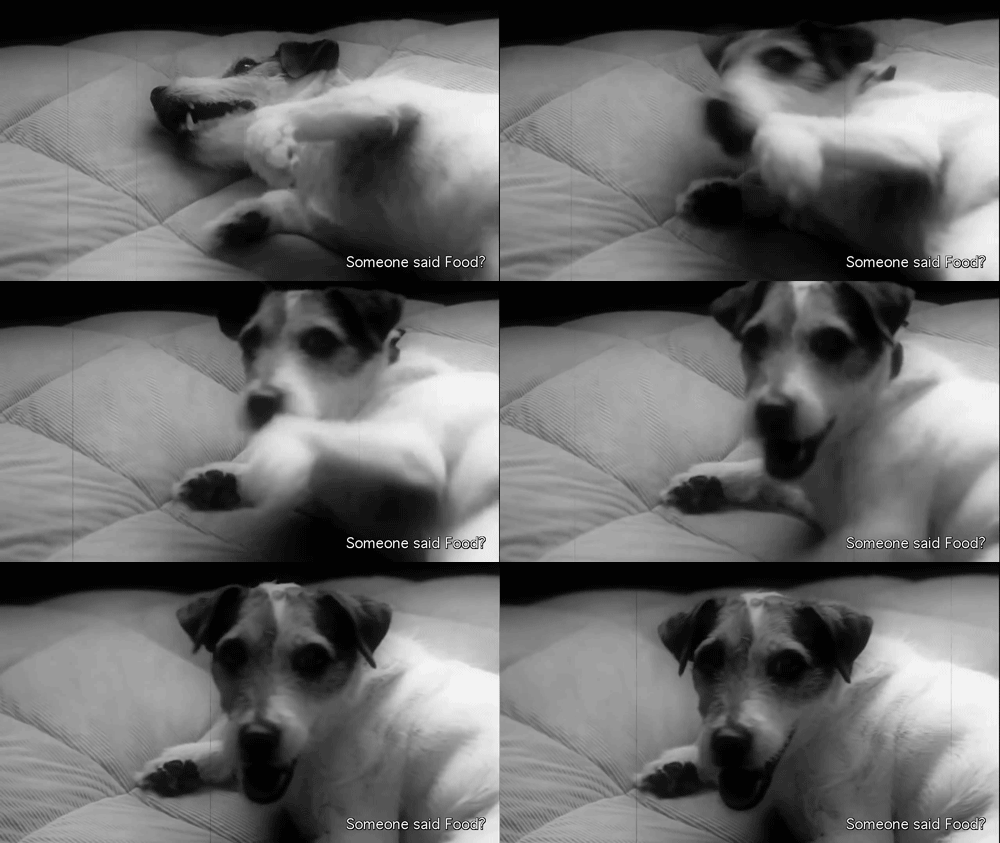
What was really interesting here, was how I processed the frames on the film clip differently. When you look for 6 to 12 seconds of film your attention goes to the question: where is the essence of the motion? I worked out that you focus on the moment of change. In this case from Uggie lying down to him getting up. I was pleased with the output above – it was smoother than other gifs I have made and caught the exact moment I wanted really well. Time for the next step.
When I read the tweet again I noticed ‘fast cut bit’. Hmmm. What on earth is fast cut bit? I went looking and found out that Uggie just would not do. He was not fast cut, poor darling. But I was hooked on Uggie’s gif and I also realised I did not know what Michael meant when he said ‘throw out as many frames as seconds’. Did he mean include in final gif as many frames as seconds (this is what I thought it meant at first) or did he mean delete as many frames in each second as the total number of seconds – if a 12 second film, throw out 12 frames per second?
This shows up an interesting element of learning online, we use what we can and are very aware (at least I am) that those part of the DS106 community give their time freely online and have busy day jobs. I try to not ask for help unless really stuck. I felt I needed to try both options first and then if I could not work it out, contact Michael.
Ahh! but there was that other technique to try – there is always another technique to try – the white lines to create depth and a 3D effect on animated gifs. There had been chat on the DS106 hashtag about these gifs and they did look cool.

I went looking for tutorials and found a great one that also had a .psd file of the lines so that you could see how the whole thing was done,
@johnjohnston this may save sometime.https://t.co/zRwoUNWxtS somebody has done tutorial for 3D gifs @twoodwar #ds106
— Mariana Funes (@mdvfunes)
I watched, got sick of the Japanese pop soundtrack, watched again. Spent hours trying to get it to work and failed. For the sake of helping others I will post my crappy attempt here <hiding head in shame, should know better>
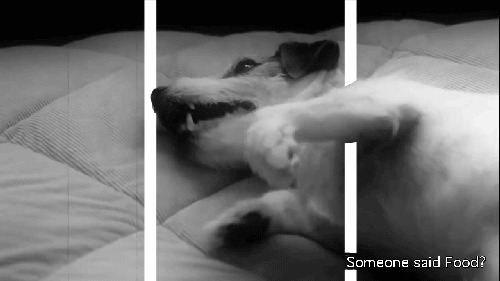
I call it the ‘bad-Uggie-Gif’. I spent hours, deleting bits of white lines and finding that it just did not gif with the white lines added. Some peculiarity of the template I used I imagine. I so wanted to make it work, I asked Tom Woodward, another ‘animated gif whizz kid’ in the DS106 community, for help. He said he would try if he could, and he did.
@mdvfunes Here’s a quick effort. I changed the lines from vertical to horizontal bc of movement. http://t.co/8BDRu7quIF #ds106 #gif
— Tom Woodward (@twoodwar)
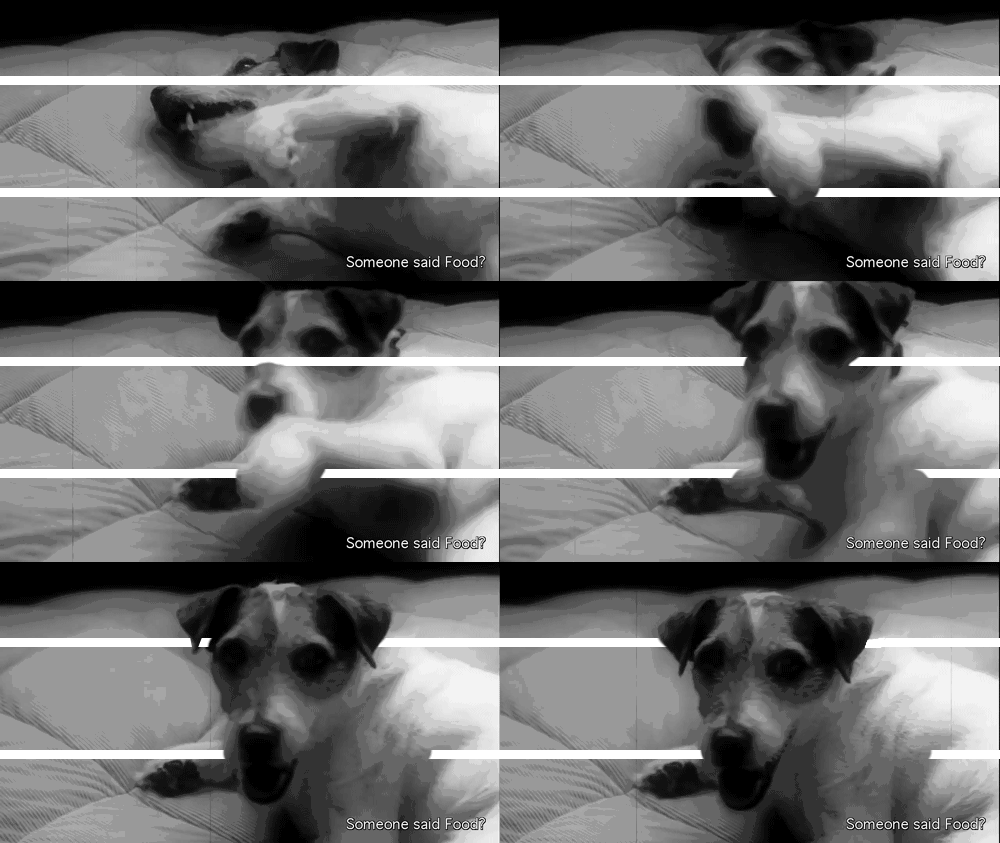
I cannot stop looking at it! I think he deleted quite a few frames as well as changing the direction of the lines. I don’t know if he uses Photoshop or anything about how it was made. I always download and load into Photoshop to answer as many questions as I can about them. It would be better if i could have a chat and ask – this way is slower but arguably I learn more as I experiment with what others make. I thanked Tom for his gift on Twitter and he responded,
@mdvfunes Ha! Glad to hear it. Animated gifs are the gifs that keep on giving.
— Tom Woodward (@twoodwar)
I will make the darn lines work. I now have a lovely Storify made by another DS106er, Rochelle Lockridge, that pulls our conversations together.
And I still need to get back to that original tweet from Michael and learn the altered state gif technique. I may need to find a different film genre to find my fast cut film clip to attempt it. Yes, DS106 never ends, it is #4life and cult deprogramming is expensive!
@jimgroom Exposed me to new “networks”? I had to take out a second mortgage to pay for the cult deprograming #ds106
— Scott Leslie (@sleslie)
Want a ‘business model’ for your MOOC? Remember that open is as open does and that is about attending to community not counting beans.
_______
Update
The conversation continues on Twitter. I learnt that the z axis was compressed on the Uggie clip and this made it harder. I saw a few more awesome examples. John Johnston posted an awesome gif and a link to a great post on how to use Fireworks to get a good gif. He also posted an example of how the effect is used on film.
It looks like depth of field matters and picking the right clip in the first place.
@IamTalkyTina @Rockylou22 @mdvfunes @johnjohnston agree completely. DOF in source seems to add dimension as well.
— Tom Woodward (@twoodwar)
And the lovely Talky Tina has created some beautiful posts mixing, planes and pancakes and guessing games to help us understand the idea of depth more. You can find the first one here and the second one here. The lovely Tom Woodward has also put virtual pen to paper and has made some great diagrams to help explain depth using Tina’s pancakes. If I cannot get my Uggie to 3D with all the resources in this post – then I ought to be banished from DS106. Watch this space.
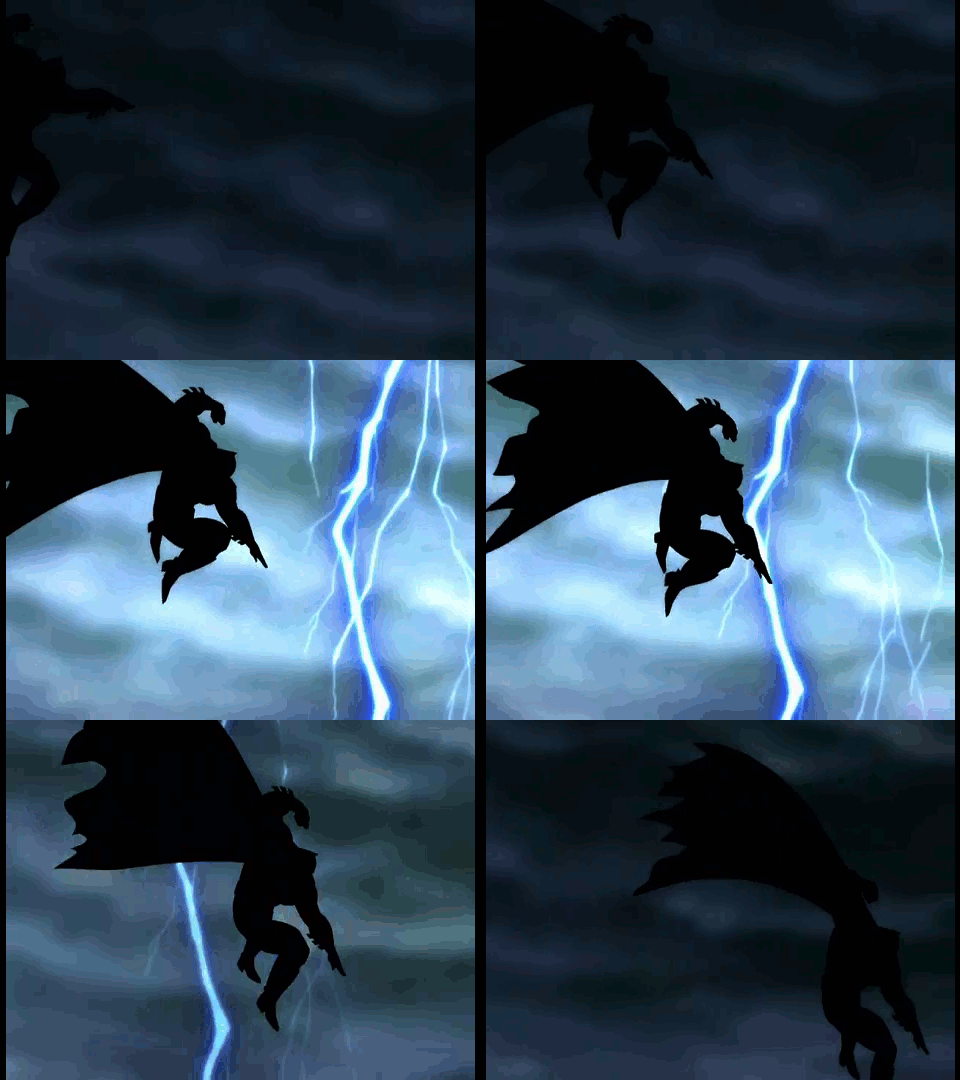

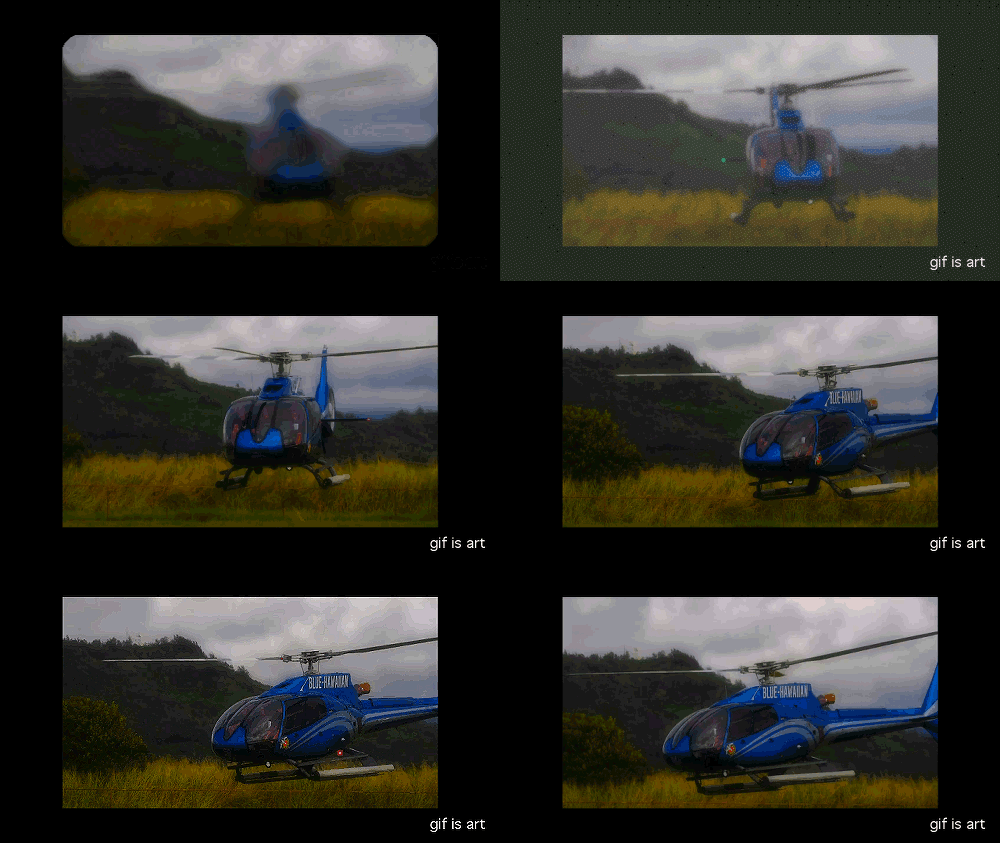

Well, I had to get back on the animated gif horse!
I chickened out of the Tate submissions as I fear I am just not good enough to enter. I failed splendidly at not being scared.
Then I saw this,
#ds106 Just published “Kau’ai from a Blue Hawaiian Helicopter ” on @storehousehq: http://t.co/g4FzIUBFwy This app rocks!
— Sandy Brown Jensen (@sandramardene)
and as Sandy has mixed feeling about gifs Alan Levine joked with her in relation to the video that opens her amazing adventure from a Blue Hawaiian Helicopter:
@sandramardene That is quite lovely! And (ahem) that helicopter seems to (cough) animate in some sort of (ahem) loop l-)
— Alan Levine (@cogdog)
It is worth reading the whole conversation which ends with me jumping and saying:
@cogdog @sandramardene I will make it into a gif, but wait it already is a…. you did it! made your first…. 🙂 what colours. wow.
— Mariana Funes (@mdvfunes)
I could not resist. The helicopter video was begging to be giffed. I downloaded, Mpeg Streamclipped it to pick my ‘moment’, then Gimped it as I like to do basic editing on there first, Photoshopped it – learnt about Tweening to get the helicopter to emerge from the mist and played with various other filters. I added the watermark ‘Gif is art’ alluding to John Johnston’s post about the the other day. There is much I would do to make it better, but not tonight. Thank you Sandy for getting me making art today – I have been too lost in meta-talk and not enough doing!
I need to show my hand and say that my favourite of all the Tate’s Gif submissions is the one the one with the skeleton, of the ones I have seen from us here in DS106…I love them all! We will win, one of us will win….
The DS106 Shrink reflects on #rhizo14
And here is the link to watch it at the Zeega site.
I am told that anyone can remix – tool is new to me so unsure about that, but if you know how and want to, remix away.