Page 20 of 36

We are on a mission from Open

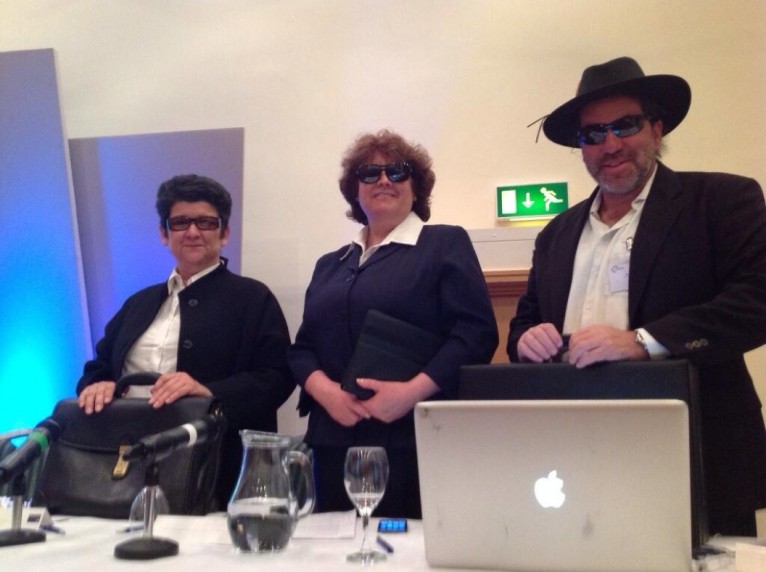
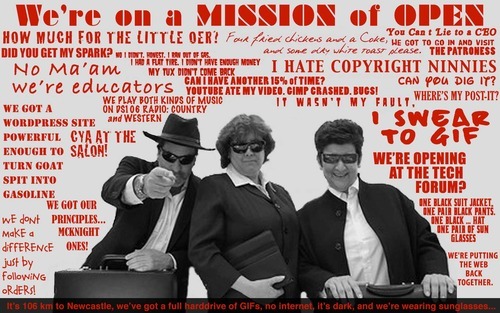
It’s 106 miles to Newscastle, we got a full tank of gas, half a pack of cigarettes, it’s dark… and we’re wearing sunglasses.
image

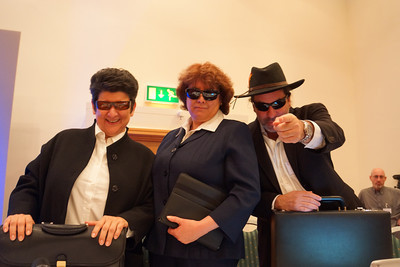
Remixed from Alphacoders wallpaper http://wall.alphacoders.com/big.php?i=204775 with OER 14 photo by Simon Thomson (@digisim)

As we sat down to plan, my most important concern was prepositions. I did not have the cinematic background to the Blues Brothers, so I did not know  all the appropriate quotes! Was it ‘of’ or ‘to’ or ‘from’ open? Alan looked at me as if I were from outer space. The quote is ‘We are on a mission from God’ – he said. Well, the poster said ‘of’ and I thought it should be ‘to’. We agreed to go with the poster as we did not want to edit it yet again. 

A big thank you to @digisim for a great photo.
image

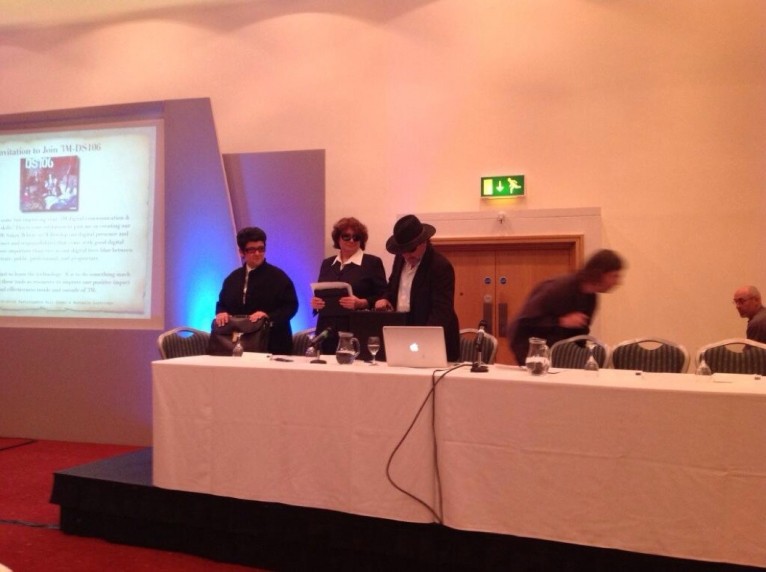
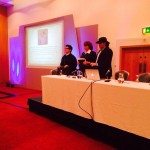
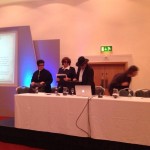
There were other photos and we had a lovely time role playing a traditional business meeting with me as the mean boss. You had to be there.  But here is the presentation we did not use. It was designed to be as boring as we could muster to contrast with our actual talk.

If you want to read the paper you can download it from my Mendeley account. There is much I learnt and much I could say (as ever) but I want to focus the rest of  this post on how DS106 can go to work and make it better.

First the presentation. I have done many presentations for my corporate consulting work and for other academic conferences. Mostly using snazzier, perhaps more creative, presentations like the one above. This experience was different. DS106 gave us (me?) permission to be silly and tell a story. Yet the story we told was deadly serious. 

We included the audience in our ‘meeting’ and it was a conversation rather than a presentation. The content was about how one person in one small area of a large organisation is bringing DS106 behind the corporate firewall. 

As a organisational and people development specialist, I cannot stress enough the potential I see in this small ‘experiment’. We have evolved a model for developing people in organisations that uses internal employees rather than consultants and that has the potential to bring the whole of the open educational web into any organisation that sees the potential. I see that when Jim Groom and Martha Burtis talk about the 3 faces of open they have given us a distinction that could change organisational development for good. We can develop open pedagogy and open community behind the corporate firewall, yet it is entirely appropriate for us not to have open technology in corporations. This led us to speak of ‘the open organisational web’ and to the creation of an expert lynchpin to act as network connector between the corporation (3M) and the part of the open web that is DS106. Rochelle has excelled in this role she chose to call the Patroness of the Salon as a homage to early open education.

The experiment is being extended for another year at 3M and I am now interested in exploring how a model like this could be generalised to support learning and development in other organisations. I see myself as a coach to other internal employees who may want to take on Rochelle’s role but may not have the ability to live and learn in the open web. Looking to some of my corporate clients interested in experimenting as I write. 

The presentation went really well, people had fun and we interacted around serious issues in a relaxed way. When I next coach one of my clients to give that all important presentation to their executive, I will introduce digital storytelling into the process as well as the psychology of communication. I cannot wait. 

Next is what I personally learnt. I learnt how my own assumptions about what it means to be a serious academic can be successfully challenged. Hell, never again will I equate knowing my stuff with being boring as hell. Taking time to tell my audience stuff they can read in the paper to impress them is really not necessary. People prefer to be included in a conversation than deafened with me on permanent send.

DS106 #4life indeed. Both at home and at work. Thank you Alan and Rochelle – it has been a joy to learn about online collaboration with the both of you. You have given me a best case example of what is possible. The how of that, will be for another time.U

 Update:

We did a show on DS106 Radio talking about the experience of DS106 goes to OER14. You can listen on Edu Talk.

Rochelle wrote about the desirable (?) difficulties of referencing for her first academic paper manually and the late discovery of technology to help this process. 

Alan has written a  balanced account of the presentation exploring the Blues Brothers theme and the more technical sides of the presentation.
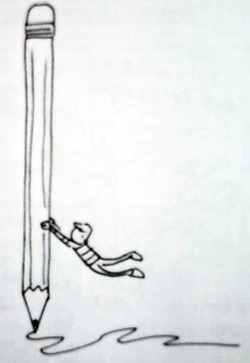
in which i attempt to ask the most overused question of all time: how did you learn to draw? and then there’s a follow-up: where can i learn to do that?

incidentalcomics:

Great question! Unfortunately, I haven’t taken any art classes, aside from a couple in high school and middle school. I got angry when my 7th grade art teacher told me my drawings of hands relied too heavily on outline, but I think she was probably right.

I learned to draw comics by studying the work of cartoonists I admired. I’ve been most influenced by the loose, expressive drawings of Roz Chast and the precise, minimally designed panels of Tom Gauld. I think that drawing style and ability is fluid – it changes drastically over the course of a career, and sometimes over the course of a single comic strip. I try to constantly search for new visual influences to inspire my drawings, and I still get frustrated at my artistic limitations.

My best advice is to become a connoisseur of color, composition, and line quality. Hopefully by trying to draw like a few different people at once, you’ll end up drawing like yourself. 

Wise advise on how to learn! #ds106

iphonelomo:

Flower on Flickr.

flower

I have a new name for what I like: iPhonelomo!

Looks like there are digital lomography photographers here on Tumblr! Awesome. I will be learning from them. 

A #DS106 Dog walk trying out my digital Lomography camera – my cheap plastic lens camera! 

Here is all I know about Lomography apart from I like the images I have seen associated with it.

Lomography, lomo or lomographs are photos that are taken on a whim – ignoring all the recommended techniques normally associated with photography. Lomography will fit in around your life and not control it, lomography can be described as the opposite of professional photography. 

Trust me to find something that is the opposite of something! I am interested in the analogue version and wanted to buy an Holga and start fiddling with film too. I was unsure if it would be just another gadget for the ‘forgotten gadget cabinet’ so I wondered: There must be a digital Lomography Camera. Boom!

Digital Lomo – Dont Think – Just Shoot and the site recommends certain cameras for this purpose.

I got one, it is simple simple to use and I am not sure how it differs from any other cheap camera I might have bought, but I am having a bit of fun taking strange looking photos. It looks like it will do burst and short video – already thinking about fast cut abstract giffing.

I will be learning and exploring in the next few weeks. It looks like Digital Lomography is the opposite of Lomography – those in the know only shoot analogue. Yet it also looks like Photoshop can give me Lomo-like photos. If Lomography is the opposite of  Professional Photography, and digital Lomography is the opposite of Lomography, then does that mean that I am right back to being a professional? Whatever the label – I am fascinated by a culture and community that encourages rule-breaking to create.

I cannot join it though until I jump in and buy my Holga Starter Kit at Amazon. Digital Lomography Photographers seem not to be ‘a thing’ on the Internet that I can find. So if I keep to the 10 rules with my digi-lomo camera then I may even get the one I have been wanting for years. Take the plunge into the past and real 35mm film. I cannot wait. Check it out:

Story time: A freaky Daily Create indeed

When Rochelle saw me ‘being taken away by Scotland Yard’ after this photo was uncovered of me ‘showing off my recent heist of Viking antiquities from the new Vikings Live Exhibit at the British museum’, I did say: “I just had to have it. It was calling out to me.”.

I came out on bail, gave back everything except the one necklace.

Each time I wear it, I feel like scratching my ear and get a strange urge to chew wood. It looks so gorgeous, I just cannot resist it. Lately it seems like something is hiding inside it – I feel a presence in the necklace when I put it on. 

Now where is that bone, I hid in the garden? I think I might chew on it before bed.

Created with Petswitch for the Daily Create today. This is the sort of thing that gives DS106 a bad name – I love that!

gifadog:

We are on a mission from Open at #oer14

Experimenting with a new toy by John Johnston:

We are designing a new #DS106 Assignment and wanted to experiment with the tool. Here was the brief we discussed on the twitter:

Play the PechaGif once only and record video 
Think of a topic for a presentation
Improvise. 
Record and audio track of the ‘presentation’ 
Use the animated gifs you recorded as your slides to talk from!
Have fun!

The worst part of it is that I have been plagues with techno glitches today. It has taken forever to get the video on YT. I tried to upload to Tumblr and failed. I recorded the voiceover and it did not record. Blah!

All that said it should not take long to do. 

I set the delay in PechaGif to 5 seconds. Promised myself I would use the first take – no cheating. Used Quicktime Player to capture video. Imported to iMovie. Created the voiceover as an improvisation exercise – the idea was think of a topic and wing it using the animated gifs that appeared as your slides. Todd Conway made an awesome example. John Johnston kicked us off with this example, where he used the tool to explain the tool! Get him all meta meta 🙂

Awesome tool to engage our creative improvisational brain!

“Wake up! Use Pechagif the best tool there is for a DS106 assignment” says John. Thank you for making it, John. I do not think it is silly at all.

Those of us who understand the psychology of creativity know that the type of exercise this tool forces on us is a desirable difficulty if we want to keep our creative muscles toned. Improvisation is not joke, says CNN.

creativesomething:

“The best ideas…” (Hint: let it load.)

If in watching this lovely gif, you wonder how to teach your crowded mind to take time to get ideas or just be still then you could do worse than my curated page on Scoop it on Lived time. 

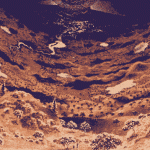
A postcard from space! You can see the interactive version here and thank your Anna Cow for the inspiration. 

I did edit the photo in Photoshop – just cropped to taste and got rid of a few colours and a little dither.

Credit photo to NASA Ames Research Center

Copyright © 2026 DS106 on the couch

Theme by Anders Noren — Up ↑