Tag: reflections

Good design – visceral, unconscious and embodied

So says Donald Norman. Good design taps into our happiness pathways and is evaluated mostly unconsciously with a small element of conscious reflection that makes us chose certain things that may not perform a function because our super-ego says we should – like buying an ecological car that only travels 50 miles before needing recharging. We buy it because it fits our espoused theories of action. So we have the object, yet remain unhappy with it. We give allegiance to the idea of caring for the environment, but operate from a theory in use that values comfort and speed. So, mental models clash. Humans are not rational animals in making decisions about good design any more than they are rational about any other realm of life. 

So, how do we teach design? How do we help students to distinguish a website that sucks from one that can be said to meet good design criteria? In DS106 we were encouraged during design week to look at examples, many examples, over and over again more examples. What this  implies from a learning perspective is that Donald Norman is right in saying that the principles of good design are below awareness. If we want to learn good design we need to develop a practice of attention to help us bring to awareness the principles we use to evaluate ‘good’ and create heuristics to help others learn perceptual patterns that are labelled as ‘good’ in our culture. A tough job at the best of times. In DS106 even harder because we look at many different types of design in a short period of time – industrial design, graphic design, photo design, audio, website design, story design, interaction design, etc. 

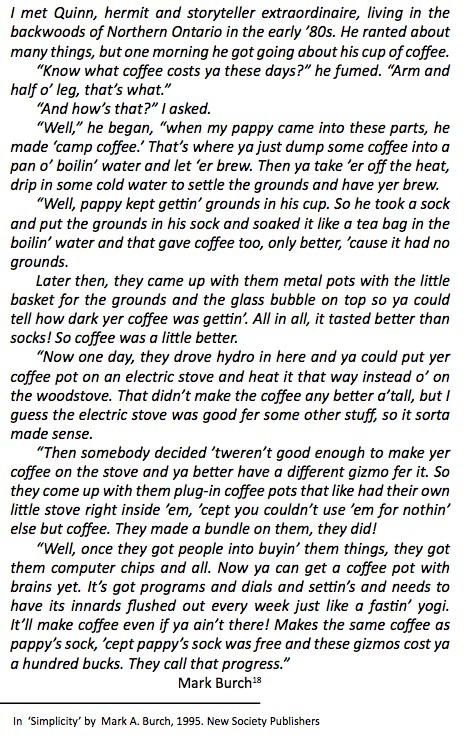
For my learning I chose to focus on surfacing my own implicit values for ‘good design’. The rest of this post looks at design week assignments and how I used them to start to answer the question: What is good design for me? First, a short story that encapsulates a key criterion of what counts as good design from my world-view,
image

At the metacognitive level I realise I hold a strong belief that there do exist absolute principles of design and that I do not subscribe to the relativist post-modern notion that beauty is subjective and anything can be seen as beautiful by somebody.

From my work in cognitive science I understand these absolutes to be tied to human perception and what the perceptual system affords as we interact with our environment. Of course there are individual differences here, but there are shared patterns too.

For example, symmetrical faces are perceived as more trustworthy and the brain has mechanisms to automatically detect novel faces and rate features as trustworthy (1) . We are pattern recognition machines, and not all patterns are created equal, even if the idealists amongst us may want any feature or pattern to have equal opportunity. I could turn this post into a review of the cognitive science literature that supports my assertion, but this blog is not for my academic work but for making sense of digital storytelling and it place in my own life. So, my assertion will have to stand and those interested can look at the research on mirror neurons, for example, as further evidence that pattern recognition is unconscious. We act differently depending on the patterns we perceive. Briefly, mirror neurons are sophisticated pattern detection mechanisms that enable us to learn without conscious attention by watching others act (2). There is also new evidence to suggest that there is a ‘neurology of aesthetics’ with core principles of what the brain interprets as aesthetically pleasing – such as grouping, symmetry, hypernormal stimuli, peak shift, isolation and perceptual problem solving – which ‘may cut across not only cultural boundaries but across species boundaries as well.’ (3) Different areas of the brain respond to elements of the visual arts such as colour, form, line, and motion, and hence our experience of art ‘relates strongly to the neuroanatomy of the visual cortex’(4). 

This research matters because it shows that there are absolute principles in design and that these are tied to the nature of embodied cognition and the brain. Put simply it means there is pattern to what we like and what we dislike, it is not all subjective evaluation. There are many other issues at play in evaluating good design – culture, politics, peer pressure, in-group norms – but here I am just attending to cognition.

We learnt during visual week how using the principles of Gestalt psychology we could take better photographs (5) and these are not dissimilar to the neurology of aesthetic principles we just mentioned. I went searching this week and found out that Gestalt has also been applied to web design (6) and learnt that the guiding principle of Gestalt is often mis-translated as ‘the whole is greater than the sum of the parts’ that in fact in fact Koffka intended it to mean “The whole is other than the sum of its parts” and this implies that the whole is perceived as different from its component parts. The article suggest that when we design anything we can usefully and purposefully ask: What gestalt principle is this element of the design appealing to? This can allow us to self assess in a rigorous rather than self congratulatory manner anything we design. I found this idea very useful and plan to apply it to the artefacts I design in Ds106.

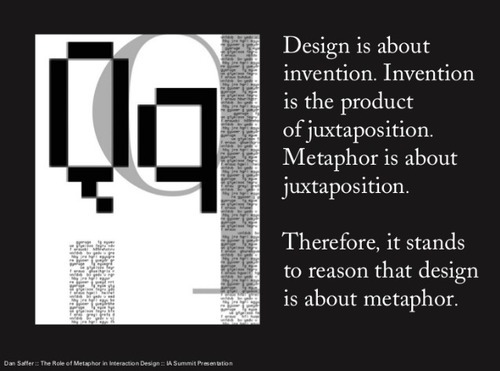
Further evidence for the cognitive underpinning of design comes for cognitive linguistics. A key slide from that presentation that connects with my own Phd research,
image

In my own work I define creativity as the process of bridging from one domain to another apparently unrelated – where the abstract gets mapped to concrete bodily metaphor (7). This is referred to as juxtaposition in Safer’s work above. The key here is that we understand via our bodies and how they experience the world. Interaction design uses metaphorical understanding to help make the tool or product invisible to the user if the right metaphor for understanding is applied. As is the case for, say, the desktop in our computers or the trash can as digital metaphors which map to embodied experience and map purposes across domains.

Our assignment for design week asked us to choose 4 elements of design and carry out a design safari – select images that represented the chosen elements. I chose:

1. Metaphor – understood as abstract concepts are grasped via embodied experience

2. Form and function – How do we blend form and function in that which we label ‘good design’?

3. Minimalism – for me understood as how do we get to the essence of things? This will give us components in a design that uniquely define/express a ‘thing’ – be it a film, a photo or website.

4. Balance – as an example of an embodied metaphor when we say good design has symmetrical or asymmetrical balance we are understanding it in relation to bodily balance.

We have learnt about many other design concepts – colour, typography, rhythm, proportion, dominance, unity. Many of them grounded on gestalt psychology. I am no designer but have always attended to design around me and have an in-depth understanding of embodied cognition and how it grounds all human endeavour.

My reading and watching for design week (e.g. Helvetica and Objectified) also offered up other interesting design principles. I loved the definition of design as ‘the search for form’. Other principles that resonated with my own sense of good design were: invisibility, simplicity, non-disposability.

The designers interviewed on the films wondered: Is the aim to differentiate yourself or to contribute to the world of design? Should we be going back to designing according to the principle of things that get better with use rather be willing to dispose just to differentiate ourselves and our products?

After my study for design week, I was left asking: How are Wabi-sabi principles useful in expressing what I value in design? Wabi-sabi contains the idea that the aim of design is for it to dissolve in natural behaviour and this is similar to the invisibility principle I believe in strongly in user interface and website design. As a buddhist it is perhaps not surprising that I value wabi-sabi aesthetics or see its application to wider ecological issues in western design. 

I was struck by a designer saying that almost all design ends up as landfill today and that designers must now consider sustainability and non-disposability . This links for me with a personal, but only just emerging, view about the negative consequences of encouraging the constant production of content for the web.  So much of it is just regurgitation of old ideas with not thought to research or good design – I am using the metaphor of the virtual landfill to make sense of this. We encourage (particularly in the open education movement) a sense of entitlement for the creation of virtual spaces – without rigour in design or content at times. May be designing content with appeal to a non-disposability  principle would give us more reciprocal hyperlinks and less withering domains,

“My hunch is most people do not consider that there are implications for this, the missing part of the original dream of hyperlinks as being bi-directional.”

Of course bi-directionality does not speak to quality. It does, however, speak to the importance of a longevity principle at least. This is an evolving theme for me, one I will come back to it in later posts. It connects for me with what I believe to be the dysfunctional relationship to time in our culture.

So, here we go, our design safari. I used SlideSpeech to add audio to the photos. It is in alpha so there were some glitches but you can hear the computer generated commentary for the photos by clicking on this link. I love this tool and have used it in my work as it can quickly produce great output. I have ran the slides with commentary on my computer, created a screencast and uploaded to YouTube for work projects. SlideSpeech is an example of a focussed tool, designed to blend with the user rather than for the user to adapt to it. We all make powerpoint presentations, and just adding key presenter notes gives you a decent artefact.

A nice feature I have not managed to get to work yet is that you can add interactivity to your artefact and offer your listener extra resources to follow up. Check this simple tutorial produced with SlideSpeech to learn how to use it. I will come back to it and want to support John Graves to further develop it by using it as much as I can – it will be a great tool soon.

Design week has opened my eyes to design beyond software and I notice that I am noticing the language of design used around me much more. For example, symbolism in advertising,

Bibliography

1.Engell, A. D., Haxby, J. V., & Todorov, A. (2007). Implicit Trustworthiness Decisions: Automatic Coding of Face Properties in the Human Amygdala. Journal Of Cognitive Neuroscience, 19(9), 1508-1519.

2. Ramachandran, V. (2013) The neurons that shaped civilisation. http://www.ted.com/talks/vs_ramachandran_the_neurons_that_shaped_civilization.html

3. Ramachandran, V. (2008). The Neurology of Aesthetics. (cover story). Scientific American Special Edition, 18(2), 74-77.

(4) Zeki, S, Inner Vision: An Exploration of Art and the Brain. Oxford University Press, 2000.

(5) Baraban, J. (2012) 6 Principles of Gestalt Psychology That Can Improve Your Photography http://www.adorama.com/alc/0013706/article/6-Principles-of-Gestalt-Psychology-That-Can-Improve-Your-Photography

(6) Tuck, M. (2010) Gestalt Principles Applied in Design http://sixrevisions.com/web_design/gestalt-principles-applied-in-design/

(7) Funes M. (2003) Bridging: The essence of Creativity. European Association for Creativity and Innovation. In: Jon Buijs, Remko van der Lugt, Han van der Meer, Idea Safari: Proceedings of the 7th European Conference on Creativity and Innovation, 2003.

Sound is like touch at a distance

I cannot even begin to talk about how I produced this monstrosity ( is that a word?) I has taken hours and hours and more effort than just writing a weekly summary for sure. I was happy with the content…but at some point I clicked ‘give me awesome echo now’ and did not notice. It was not intentional and I cannot find a way to get rid of it in Garageband. I noticed that the different clips in the podcast were not levelled. I downloaded the Levelator and hoped to even different volumes in the podcast, but it was not to be. It turns out it does not take mp3 files. 

I set out to make my first podcast and have done it. It is an example of the great gap that exists between my impeccable taste and what I am able to produce as a beginner. Still, I got practice with Garageband, Quicktime, Soundflower, Levelator, and got to listen to my ‘nuggets’ for the week a zillion times as I tried to put the podcast together. Here is wishing the next one will be easier.

Audio Giffing

As If we did not have enough assignments, I did the same one twice. 

But this did not start as an audio assignment. It started in my head as an animated gif. And that was what I planned to work on today.

Last night I was reading ‘is google making us stupid?’ again. it starts,

“Dave, stop. Stop, will you? Stop, Dave. Will you stop, Dave?” So the supercomputer HAL pleads with the implacable astronaut Dave Bowman in a famous and weirdly poignant scene toward the end of Stanley Kubrick’s 2001: A Space Odyssey. Bowman, having nearly been sent to a deep-space death by the malfunctioning machine, is calmly, coldly disconnecting the memory circuits that control its artificial “ brain. “Dave, my mind is going,” HAL says, forlornly. “I can feel it. I can feel it.”

It has been so long since I have seen that film that I had forgotten about it. The article talks about how the way we are using Google is a little like Hal dying – somebody is tinkering with our cognitive reasoning and with how we ‘do’ thinking. 

As I read the article and reflected on its relevance to my own cognitive strategies and how they have changed as a result of not having to hold information in my head, it occurred to me that the scene from the film could make a great animated gif. 

I could show how slowly we are degrading our circuits – like what happens to Hal as he ‘dies’ – and use it as an example of the potential of our decline into mere pancake people:

As we are drained of our “inner repertory of dense cultural inheritance,” […]we risk turning into “‘pancake people’—spread wide and thin as we connect with that vast network of information accessed by the mere touch of a button.”

I went searching, of course, and found this segment of the film for my next #thoughtgif.

I looked for the gif shot. I looked again. I realised that what made the clip powerful was the sound and not so much the video. Then I had an aha! moment. What if I did a second radio bumper, it is audio week after all, with Hal’s song? I followed the same process as in my previous post and what you hear above is the result of me playing with Garageband a second time. My first audio gif is how I see it.

What was interesting in this assignment is that I did several trials of the radio bumper – I was not happy with the results and so kept trying new ways. I had feedback from Alan Levine that my original radio bumper was a tad long so I wanted to cut this to make it shorter. I was reminded of something that Alan said about animated gifs

But when you go through a mindful process – identifying a subtle piece of the world to isolate, or a moment/character in a film, it gets interesting.  But for a film clip, it is this great reductionist process to extract a few seconds form a larger work, focus it down to a short video clip, then import into Photoshop/GIMP, and reduce it even more to a number of frames, and reduce it even ore to emphasize the moment, or reduce the file size..And when you get to the point of being able to isolate movement to just a small portion of a frame you have arrived to an artful process.

 The process of isolating smaller and smaller elements to produce an artefact that fits certain aesthetic criteria does require one to engage the tortoise mind or cognitive unconscious. i was fascinated that this could happen through the audio channel and that it was as absorbing as working on a video clip. I wondered, what aesthetic criteria I was applying as I have not got a clue what makes good or bad sound. Yet, beyond length, I kept thinking about the potential use for the artefact ( a late night programme on the affairs of the mind) and kept rejecting successive versions. Why? What did I change? Well here is where I lose track. I got lost in Garageband and ended up with a version I was happy to share. I changed many aspects of the sound, moved tracks around, used different effects. I even tried looping the audio – as animated gifs loop forever – but that seemed overkill. 

I end my DS106 day with a number of insights about my process. I am not thinking about my output as art, in the way Alan and others in DS106 do. I like to do the same thing more than once to get to understand the tool and the process. I need the tension of opposites to create anything and it is hard to create this in DS106 as there is not tension between what I want to do and what I have to do. So, this morning I got ‘distracted’ with kinetic typography, wanted to go off and do more of that, and then made myself come back to what I ‘had’ to do. Of course, this is just mind games as in this case there is not even the semblance of me ‘having’ to do anything. It seems I need the sense of struggle to produce. No doubt I will continue to explore this in the next few weeks. Some questions I am asking:

  • If not art, then what?
  • Why not art?
  • What does repetition give me?
  • Could I find more skilful ways to engage creative psychological tension?


Can’t spend them fast enough…

…the bags of gold, that is. 

I am suffering from RSI on my left hand after spending far too much time on the computer with DS106 creating. My body is saying I need to manage my excitement and spend the bags of gold I am getting wisely.

For this weekly summary post I decided to select from all the notes I made this week – see tag cloud above (you need Silverlight to view) – and write this summary post to help me reflect on the biggest bag of gold I found and how it relates to my teaching:

As I started to work through this week’s materials, I set out to read Gardner Campbell’s article.  I thought I would just scan it as I have read it many times before. But then I had the idea to use Tapestry for a second time this week to get some of those nuggets of gold we were told to keep for future weeks of learning,

Keep track of a key sentence or sequence in the video that generates interest or questions for you, […] Gardner calls these “nuggets” and will be launch points for our discussions.

So I started a Tapestry story instead of highlighting text. This seems important in the light of the metacognitive strategies we develop as  a result of the tools we have available to us. The ways we start to re-imagine learning. I had used Tapestry before to respond to a question by Talky Tina and had moving feedback from her about it. I always like to use a tool a few times to get a sense for what is capable of.  I added the beautiful summary by Julia Forsythe as my opening screen and left a comment on Flickr for her – as I thought this was a beautiful artefact. I kept on reading. I highlighted and copied onto Tapestry key nuggets – not before going into Gimp and stealing the little bag of gold from Julia’s drawing for use in the Tapestry!

.image

Seeing the quotes on Tapestry and organising them made me think about the content of the article differently. I saw a theme I had not seen before – the idea that in the construction of a cyberinfrastructure we are composing a life in the sense Mary Catherine Bateson means it – in a life of discontinuity we need to compose a life rather than plan it. The nature of the web is such that it affords purposeful composing. I looked for the book and found out that she has now written a book called ‘Composing a further life’ and though it is a book about life after retirement, I thought it applied equally well to the ‘further’ life we begin to live online as we decide to put down a few virtual identity markers.

I added this nugget to the Tapestry. My Tapestry was looking decidedly linear and non-arty. I had the idea to select images on the basis of what Gardner said on the video we were also asked to watch. I got Flickr advanced search for CC images and Savvy Gimp free images finder ready and started the video. I completed the Tapestry that way. 

Images were all creative commons, although I should have got attribution written down under each – I was simply too tired to do so. In that sense creating openly is more time consuming that just making notes privately. Here is a link to view fullscreen.

I developed a new way of ‘studying’ using the tools of the open web. I guess this is what Gardner means when he says the old sometimes gets in the way of the new – if I had used my usual mental models I would simply have scanned the article and left it at that. As I had the frame of making art for DS106 and I was on the open web, other ways of studying presented themselves. 

I can already see how my own teaching will be changed by DS106.

I will want to include some of these ways of learning as options for my students. These are the bags of gold….but wait, is it safe? Can we do the same thing behind the firewall of my organisation? Here comes the illusion that the digital facelift is the same thing as composing a digital life. It is not. Wish me luck trying to persuade the powers that be in my world to spend the gold. I am encouraged by some digitally subversive action from other DS106 participants:

This week will be work in progress for several weeks. There are so many nuggets. I will pace myself and right now I am trying VideoNot.es, having tested Vialogues along the way, I prefer it because I can just keep notes on my Google drive. Vialogues is more like a visual Voicethread and more a sharing tool than a note-taking tool. I will work with the video for a while and keep reflecting on the ways in which taking steps to build a cyberinfrastructure challenges the way we teach in non-digitally aware institutions. The faculty may be up for being open to the world, they may consider opening up to each other with ready processed material, but how could they ever be persuaded to open up to themselves and be willing to critically reflect on habits of mind to increase self-awareness? And share these vulnerabilities with their students?

The dangers of too much reflection…creating something bigger than ourselves!

A keyring tells of desire for privacy

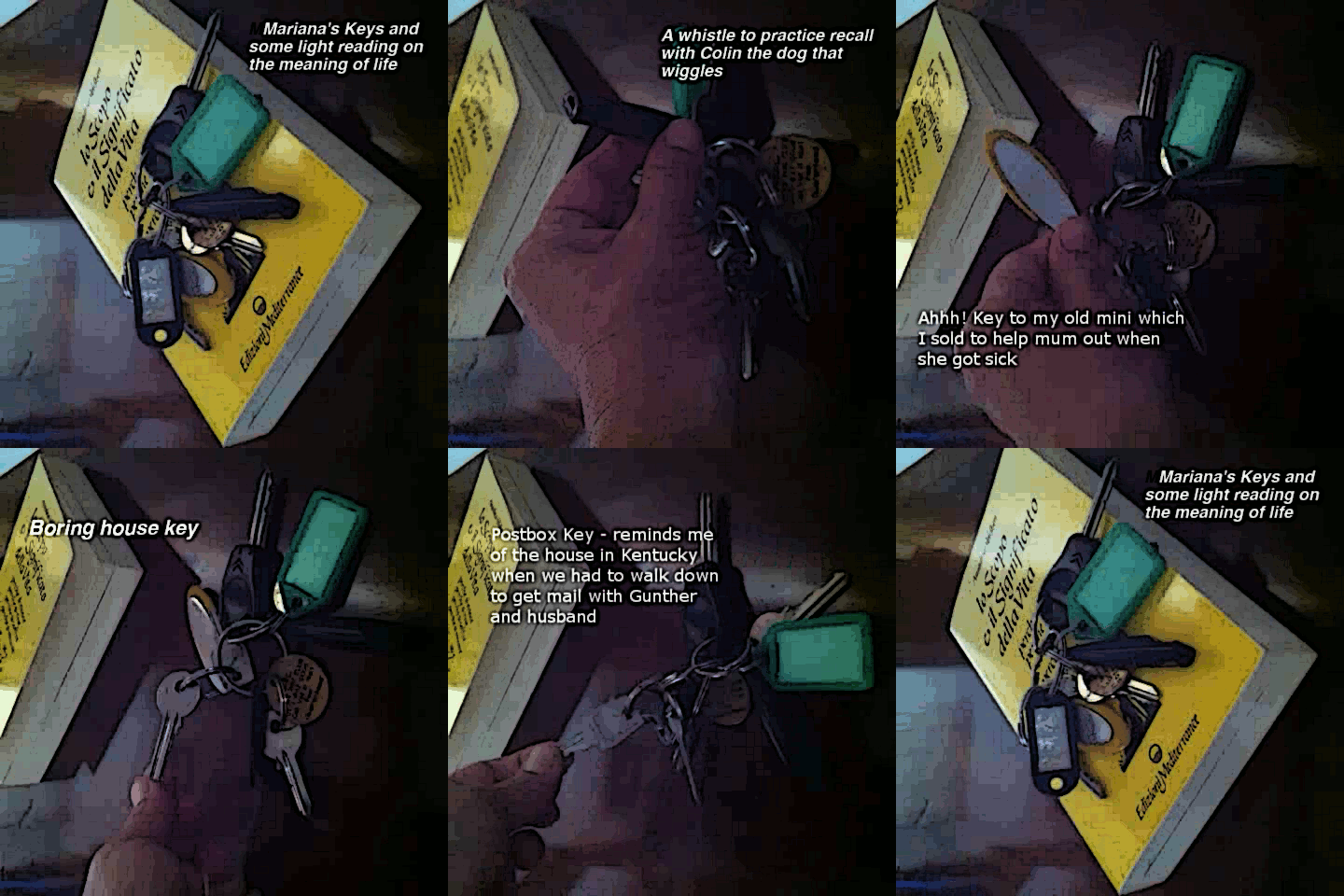
As I start to see habits of mind reflected back on the digital echo chamber that is the web – I hit against another pattern in trying to do Daily Create 603 which is also an assignment for week 2 of bootcamp on Headless 13 Ds106. The brief is simple, tell us about your key ring and stories about what you have on it. As is often the case with disruptive wonder, making the ordinary extraordinary, it is rarely as easy as it seems if the focus is on critical reflection as well as artefact.

I viewed a couple of examples. One by Alan Levine – he tells a moving story about the meaning of the items in his keyring. Direct to camera, no disguise, sat outside the porch his home. I loved it, and I was unable to reciprocate. It frightens me to be that open on a video I will need to upload publicly to You Tube. That is the truth. I really wanted to do the same – show you my keyring, my home, I would have had to get Colin the dog in the story somehow, tell you about my history via the items I carry with me – for example the key to the postbox that reminds me of my life in Kentucky cut short by the death of my husband – and I may even have wanted to show you the equivalent to sitting on the porch which for me is looking at my view from my back garden. But it was not to be because fear to be public on a YouTube got in the way.

I saw another daily create that was a photo showing a vacation location – not very disclosing but with a promise to do more on  returning home. Yet another, with a story about one key that said something about the person’s history, yet did not show the person or have the person talking directly to the camera.

Many examples of people working with the boundary between the public and private and finding a place of comfort to share with strangers. I struggled.

I wanted to be as open as Alan, and found my need for privacy, and my fear of how what I put on the web may endanger me in some way, stopping me from sharing openly. I am aware that I am a work in progress as regards open education – I have a need for privacy and yet want to join in. So, I will do it over time in a way that is respectful of human fears. 

A fear reinforced by something that happened recently. 

On my first public hangout, a hangout held as a team meeting for an Open University programme, I found out about trolls on You Tube. It was a really unpleasant experience to know that strangers had been watching our team meeting and writing nasty comments as they listened. As I did not know how to get comments on a hangout as it was happening, I only found the comments afterwards. It turned out it was just a couple of kids wanting to interact and getting frustrated because we were not responding to them. No big deal. Yet it was a big deal to me.I spent the next few hours learning all there was to learn about back stage on YouTube – disable comments, hold videos unlisted if possible, make sure your public profile offers honest information, but not so much that you may be put in danger. Of course, some might say, where is the harm? If you get nasty comments just delete and move on. Yes, that is what I did as well as blocking the kids that had left the comments. But this misses the point. In choosing to have a digital identity one is choosing to be, to a greater or lesser extent, in a shop window. Some shops are exclusive and others less so, but still your shop window can be visited by strangers and not all have the intent of getting to know you and use the web in the same respectful way they might use your front room had you invited them there. This unpredictability both fascinates and terrifies me.

It fascinates me that it led me to DS106 and meeting such well intentioned people, it terrifies me that it can also be responsible for causing harm to people unaware of its dangers. So, the jury is out as to how exclusive my DS106 shop window will be and how much I will be willing to disclose to all, when in fact I may only want to disclose to a few. I err on the side of caution today and try to find a way to tell fellow Headless13 participants enough about me that they may feel I can be trusted, but no so much that it could be used to be hurtful to me or others. I have written about my privacy strategy as I build a personal cyberinfrastructure elsewhere, it is a difficult dynamic constantly under review.

What is interesting about this Daily Create is that I run similar activities on my face to face courses to help get people familiar with each other. They too choose different levels of disclosure driven by their own fears and habits – in that sense the difference between the virtual and the physical is not that great. We each bring our dysfunctions to how we interact with others, online or otherwise. Some people may have complied with the brief and disclosed more than they wanted to please others, some thrive in the potential of an audience and disclose all, others will not do the assignment not because of technical issues but fear. What about this headless shrink? Well, I am putting myself on the couch by doing DS106 as each assignment helps clarify a new pattern. This is the intention with which I am engaging on this course – can it support a contemplative practice as I live my life as inquiry.

What about the keyring video, then? 

Well, I did a Vine video without my voice or face. Just the keys. This erred too far on the side of privacy. So I went on a search of how to download a Vine video and found something. So I had an MP4 file that I could not load on to Movie2Gif , so I then looked for a converter and found an easy one. What was my plan? Well I thought I might turn the movie into a slow motion gif with added text to tell the story. That was 3 hours ago. I have no idea of my workflow beyond that – too many frames needed reducing, video quality needed improving, background noise had to be removed – eventually I found myself in Gimp with a few frames from the video to build the gif from. Easier said than done, of course. I was determined. So, I looked for more information and tutorials to allow me to execute my plan. Went via advanced tutorial on the Gimp site, which just do not work for me and found a noddy guide to setting delay in frames. It is so easy! When you worked out how, of course. I spent an hour or so playing with delays as I thought this may come in handy in the future. As I now can add text, via add layer and merge down layer – I practiced that. I still cannot get the text box to move – a mystery as drag and try to move the text moves the whole layer. I need to work on selecting the right stuff. I also found out that there is something called GAP that I think will let me (finally) work with multiple frames and see animations more clearly but it is too hard to learn today. 

And after all that, what was the result?

image

meh…just experimenting, it is ‘kind of’ what I had envisioned but lacking in a certain elegance I aspire too. It is too dark, that cartoon filter could have been left unclicked. Elegance will have to wait for another day. Achy RSI hand says ‘step away from that computer….’.

But I was told to upload to YouTube. Off I go searching again for a converter. This time .gif to .mov via YouTube help to find out about supported file formats….and voila same thing but as a movie again…started as a movie finished as a movie and helped me learn a few more Gimp tricks and reflect on what it means to have a public digital presence. I love DS106. 

Addendum – using this inferior Tumblr platform is teaching me more HTML than I ever need in WordPress! I like things to look a certain way, and here I have to work for that. In WP it is all taken care of beautifully. Unexpected.

Of kitchen monsters, the making of Talky Tina and making impressions

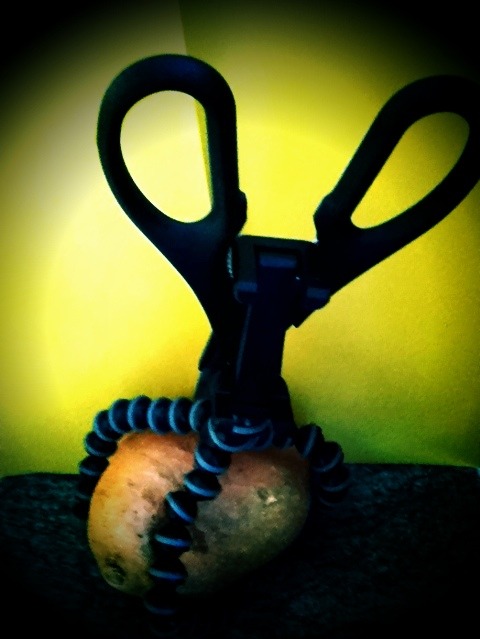
First things first, let me introduce you to a monster from my deep unconscious. It emerged this week on a request from the Gods of the Daily Create to ‘build a monster out of items in your kitchen and post of photo of it.’ Well, may I introduce Jobytopus:

image

He came alive to terrorise all potatoes in the kitchen and to allow me to photograph him in flagrante delicto with my new Camera+ App which I saw a dog use and hence have assumed it must be good – if it is good enough for the dog, it is good enough for a budding photographer who never wanted to be a photographer. Why not? I believe that it encourages living life for an audience rather than engage in the moment. But that is a story for another time. I am challenging my assumption on DS106 Headless 13 so I have started to build a Flickr photo stream – who would have thought it? Not this Headless Shrink, for sure. 

He came to be created because I received my little Joby tripod for taking photos with my smartphone that morning. As soon as I saw the request for a kitchen monster I took him into the kitchen and started to create it. It took 5 minutes and it is the thing that has given me the most pleasure so far. It was like being a kid again. It resonated with something that Roger Hughes said in the video we were asked to watch this week:

Children have the kind of direct sensuous and complex relationship with the world around them [and] this is the lost paradise that art wants to give back to us as adults not as children.

It felt like I connected with the lost paradise of art as I created my monster. Of course, there is not telling about the quality of the output but Martha Burtis told us this week to:

Reflect critically about your own creations over the 6 months.

I love my Jobytopus and I will reflect critically on it over the next 6 months. meantime I chose to use it again on the next Daily create I chose to do this week. The task was to edit an existing video clip to include an unexpected object in the story. 

I had heard about Onetruemedia  from other DS106ers and although it was late in the day, I decided to give it a go. I felt it would count as an existing video as the site offers ready made video templates to drop your stuff into. How much fin was that to make? Well, I was on EST now. What is EST? Let’s ask Talky Tina:

It IS a timezone. It is a very cherished timezone for some ds106radio people and it is called the Eternal Sleepless Timezone

I get the feeling I am going to be on EST a lot in the next 6 months. How much fun can a person have whilst learning? The biggest challenge has been to stop creating and start reflecting. But critically reflecting on what we make, learning to evaluate the quality of what we produce as well as the fun quotient is an integral part of the DS106 process. It will be hard, it is very easy to get into making without reflecting. 

To help me with this process, I have started an experiment. A private but open reflection space on Google sites. Let’s face it, who can ever find a Google site? I might as well be writing on parchment. I plan to do my weekly summaries there and use it as my rehearsal space. I need that. 

Here is the video I made on Onetruemedia. 

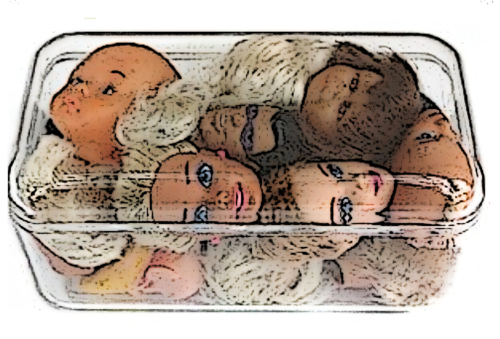
I had an exchange with Talky (as I now affectionately call her) on the Twitter and asked to be paid a bucket of heads for the video!

image

The least said about bucket of heads metaphors to learn about digital presence and storytelling the better. I did get a screenshot of the heads from another photo and then took the opportunity to pretty it up (sic?) in Gimp before sending to Talky. My evaluation is that it does not look too bad for a quick edit – but I know nothing yet about how to get photos to look right for different media. I just mess around and see if I like the result and this is not exactly Masters level.

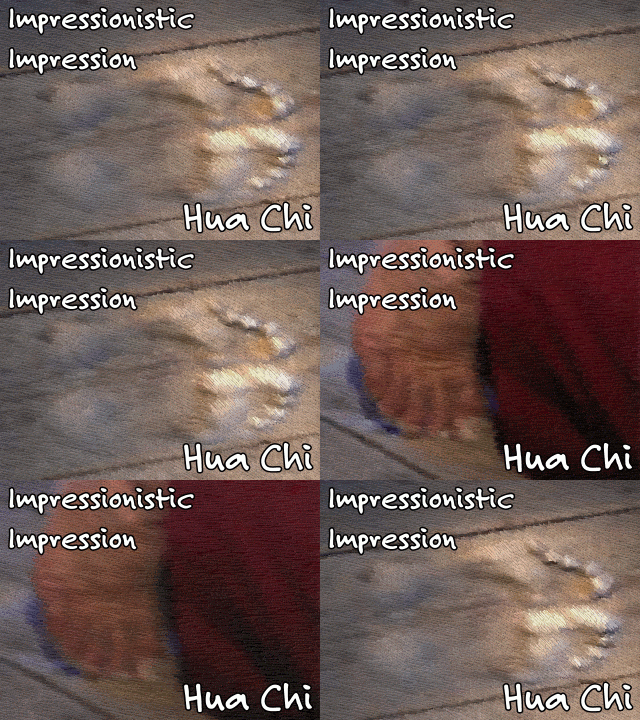
I end this post with my final insight for this week. Animated gifs don’t have to be funny, one can create thoughtful gifs as well. I experimented with my first #thoughtgif earlier this week. I liked the concept so I decided to apply it to another daily create from this week. It asked us to make an impression: take a picture of an indentation. I made this:

image

As soon as I saw the daily create I thought about the footprints of Hua Chi and wanted to do something with that for this daily create. I also wanted to learn how to make animated gif from film without having to look at a tutorial. I wanted to run solo and get one done. I succeeded. I was not able to add the text I wanted on Gimp (I still struggle with layers – I wanted to add a top layer with text and who knows how to do that in Gimp). I am nothing if not determined when I get something in my headless head, and I wanted the text. I remembered that Google Plus allows you to add text to animated gifs when you upload. So, I added the text, downloaded it my computer again and then uploaded it again to Tumblr. 

And this is only half way through the week, and just scratching the surface of all I am learning. I was annoyed at stepping out of daily creating to reflect today – but even this was a good reminder for me as an educator of how hard it is to stop and reflect when you want to keep acting in the world. My students struggle with pressing pause and today I had a reminder of why.

And suck it Tumblr – I found out how to get my posts to look like I want and embed my media where I want. I am not going to need to meet you up the stairs with Talky during the next 6 months. After that, I will go back to my WordPress blog because your editor truly sucks.

Killing 3 birds with one stone

So I have been dancing with Jim Groom in every room of my home.
Steady on. Strictly speaking I have been watching him dance on my laptop  in every room in my house. As a new recruit to the DS106 community and trying to limber up for Headless Ds106 about to start August 26, 2013. I have been splendidly failing at keeping up with the July challenge to do a daily create every day and with the August challenge to do an animated gif every day. Why? because I am learning to use new tools and they are hard!
So I had an idea for this post that should catch me up a little. This post will take care of 3 daily creates with one post!
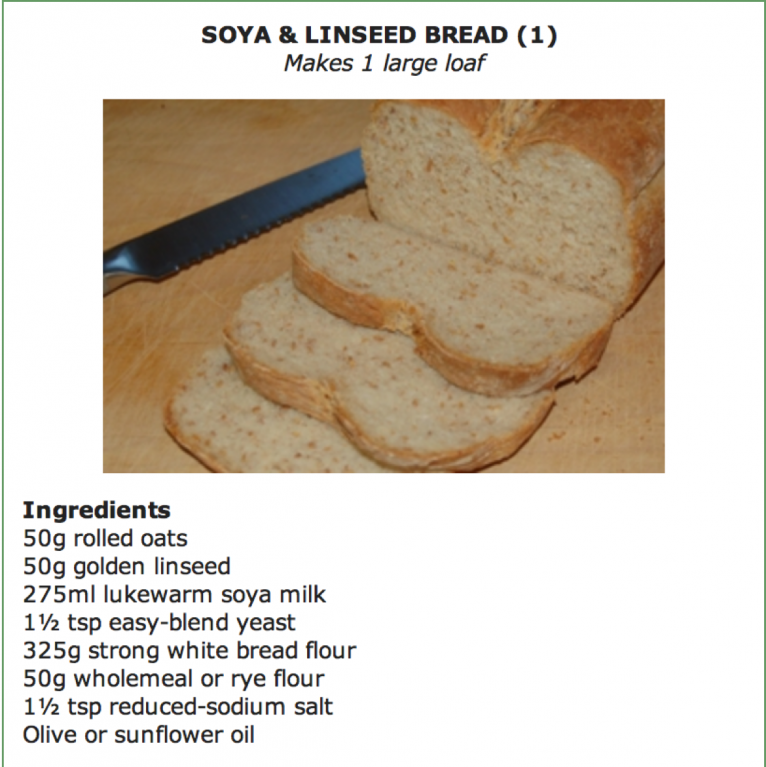
For Daily create 585 we have to ‘share a recipe and a story of why it’s so special to you’.
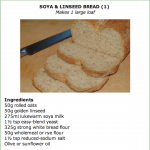
So the recipe ingredients are included here.
What I do with the ingredients is put them all in a bowl and then wait till it forms into a lump which I throw in the oven for 45 minutes. That is it.
Why is it so special, then? It was the first thing I learnt to make when I was told by doctors that diabetes was around the corner. I was angry at first, I like to eat when I want and what I want. But as a result of the diagnosis a few years ago, I learnt to cook. I now make time to buy the right food, cook the right food, and love doing it. Over the last few weeks I have been worried about my dog’s health and so had been neglecting the kitchen and my own health. He is now full of beans (healthy) again and so when this daily create came out my bread was coming out of the oven smelling gorgeous.
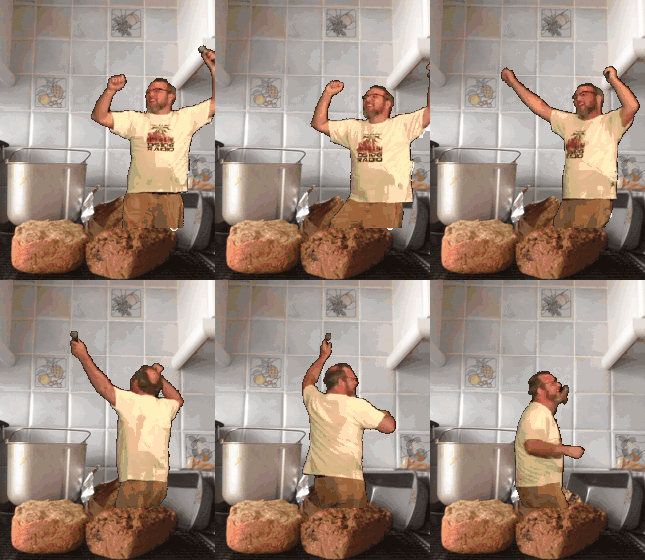
I then had the idea to get Jim dancing in the photo I took of my bread coming out of the oven. I could make my first animated gif and take care of another of Talky Tina’s daily creates: Dancing Jim all over the world.
Easier said than done. I made several attempts over a number of days with different photo editors. Hours and hours watching Jim dancing and trying to get him inside the baking trays, over the bread, wishing I could make him explode like John Johnston’s Headless poster, all to now avail.  I ended up feeling like my little animation above.
But then my true friends came to my rescue on Google Plus DS106 space  I posted my failing gif, a couple of tutorials that had not helped me but made me feel stupid as they made it seem so easy!
I gave up and then started again. As Piers Ibbotson, the theatre director, said to me last week: I am utterly uninterested in the fact that my actors get it wrong, i just need them to do it again and again until it works. So I kept doing it again and again until (drum roll) it kind of worked,
And so we come the third daily create this post is covering: ‘Create an animated gif that Sandy Brown Jensen will respect’ 
I posted my Greedy Jim on Flickr and here is my comment to explain why I felt this gif counted for this Daily Create:
Sandy,
I hope you will respect this one as it has taken my over 10 days and several photo editors to get to a (reasonable) shape. I love gifs, but I never knew what it took to make them. Now I do I can only say: RESPECT to all who make them. And greedy Jim dancing around my kitchen is just funny, or isn’t it?
I know it is not great, the size is not quite right, and I had to remove one of the frames because I could not get it to line up. Sometimes it is not about the quality of the output but about what you learn getting there. I tried Fireworks, Photoshop and Gimp. I have settled on Gimp for the upcoming DS106 Headless 13 run.
I bought PIxelmator before I knew it was not good for animated gifs, it looks like a great editor. I wanted to find an editor that would give me a large view of each frame rather than have me squint into a small side window to see which frame I am working on, failed on that. Fireworks seems intuitive, but has to be paid for monthly now.
 Along the way: I cracked the Gimp, found a tutorial that makes it seem like it should take me under 2 minutes to add an animated gif to a background and a screencast that taught me about frames

And at the end of it all I felt like the minions in the gif above.

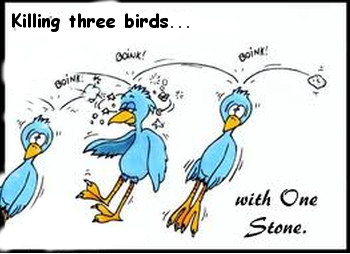
So what have I learnt? I can kill 3 birds with one stone and (drum roll again) check out the use of the clone tool in gimp in my last photo above! There were only two birds in the original.

Off to bed…have I signed up for no sleep during DS106? Having so much fun, but Tumblr is a bit sucky.

Update: I am leaving this post as is as an example of what the technology affords. It does not make it easy to create post with media place where you would want it. I have found a workaround for this – but it should not be about workarounds. 

theds106shrink:

The First Letter

I am combining a number of things in this post. In the traditional academic world we might call this cheating, I hope that in the DS106 world we might call it creative. 

We have been reading Alone Together on DS106 Book club and it has challenged my views about how I use technology in my life. The detail of that is for elsewhere, but here I wanted to tell you the story behind the gif I created with Vine this morning.

Does it count as a gif given it was totally painless?

At least, once I had decided on the composition and yes I had to record it several times to get the effect I had in mind. So, here is the story that goes with the flow of written paper above.

The book tells us, amongst many other things, that we may need to attend a little more to the tangible. I have been having a tough time with a friend and reflecting on that after reading the book I realise our difficulties are to do with our conversations having transferred to texting almost exclusively. This has led to many misunderstanding which we then have tried to solve with more texting. It was only when reading about the allure yet inherent dissatisfaction we experience with virtual communications that I realised that my friend and I needed to reclaim the conversational frontier as Sherry Turkle, the author of the book, tells us.

Just as I was about to send a text to tell her this (No, I am not kidding), it occurred to me that one way to put into practice the book’s ideas would be to write her a letter. A letter that explained my insights from the book and how I saw them connecting to our difficulties – we have both been dissatisfied about the alone together nature of our friendship of late but have not been able to name the frame. 

It took a lot of conscious effort to choose this path. Many an excuse came to mind for not doing it and yet it felt an important developmental experiment precisely because I was resistant to doing it. 

So after coming back from walking the dog around the farm, I set out to write (what felt like) my very first letter. 

I would have liked some lovely stationary, like what I used to have in the days many moons ago when I set aside whole days just to write letters to friends and family. Paper is not an easy find in my ideologically paper-free household. I have been heard to say many times ‘Paper is so yesterday!’ as many friends would confirm. Eventually I tracked an old pad, not an ipad. Pen was simpler as I have continued to love buying them, if not using them. 

Bringing mindfulness to the process showed me that I felt very different as I set out to write a letter to my friend from how I feel typing this post. A key difference seems to be a sense of urgency and get it done here versus a sense of space and engagement with my relationship as I sat in front of the empty page. 

It was a new feeling, something I had not felt for a long time.

I understand now why architects continue to draw by hand and why Sherry Turkle says we need to be purposeful in finding these spaces where we bring up ourselves by ourselves – spaces where we are alone with our thoughts in a task prevented from clicking or ‘nexting’ to the next new shiny thing. 

I have a strong meditation practice and can sit in meditation for hours. This is different. It seems to me that this was about being alone with the task at hand, reliant only on your memories and ‘forgettings’; unable to rely on the life browser that is our computer. It felt vulnerable. It felt other. I had forgotten the experience of writing in terms of habits of mind, though I spend my life writing in terms of task. 

Vulnerable? yes. I had no spell checker, so the letter will clearly have spelling mistakes. I had no backspace key, so I had to think about what I was writing. This made the process much more embodied and engaged. The most difficult thing to overcome was handwriting itself; I have not written a long letter or anything else for a long time. The physical process of writing itself felt like a speaking a foreign language – even though I am fluent in Italian, I have to concentrate and focus on simple things like buying bread when I go back to Florence, an old stomping ground from student days, after a long absence. 

The advantage of this limitation is that all that exists in the moment is that moment. In the writing of my letter, all there was was the letter and my friend. I feel like the letter I wrote was the highest quality time I have spent with my friend in a long time; no split attention, reflecting on my reading and how our friendship may improve as a result of what I have learnt. Alone with my own thoughts, my own connections and limited memories.

I plan to reinstate letter writing day in my life. I will stop sending e-cards even if that seems easy and more beautiful. I will choose to sit with my friends and focus on just them through pen and paper…until the next time I am seduced by a new app that promises to give my friends a much better experience than my boring old letter could ever do. 

Copyright © 2026 DS106 on the couch

Theme by Anders NorenUp ↑