Tag: reflections

Addicted to DS106 – A conversation with Rochelle

A while ago Rochelle suggested we had a conversation about the addictive nature of DS106. She was asking a serious question – what is the nature of DS106 that leads a few of us to dedicate more time than we have to it for no pay or egoboo and is our judgment affected in ways we do not see? She wondered about the neurochemistry of love and addiction – dopamine and serotonin in the brain playing havoc and leading to unhealthy choices.

About the same time I made this fun DS106 trailer:

I recognised the pattern she was referring to. I have spent longer than I am willing to admit trying to get an animated gif to do its thing for no discernible purpose other than I love it and fun is good. And yes, I know enough about addiction to know that addicts say the same thing about their drug of choice. If you want a funny look at this issue then you could do worse than watching Flesh-eaters Anonymous but be aware it is not for the faint hearted and its humour rather dark, more halloween than academia.

The rest of this post is a serious look at this proposition and explores some of the issues and questions we explored when we talked. An edited version of the conversation can be heard at ColinPods

Is our judgement being affected in ways we do not see? Many people who I consider wiser than me think so. Richard Foreman on The Edge explains the issue in a graphic and poignant way:

But today, I see within us all (myself included) the replacement of complex inner density with a new kind of self-evolving under the pressure of information overload and the technology of the “instantly available”. A new self that needs to contain less and less of an inner repertory of dense cultural inheritance—as we all become “pancake people"—spread wide and thin as we connect with that vast network of information accessed by the mere touch of a button.

Will this produce a new kind of enlightenment or "super-consciousness”? Sometimes I am seduced by those proclaiming so—and sometimes I shrink back in horror at a world that seems to have lost the thick and multi-textured density of deeply evolved personality.

But, at the end, hope still springs eternal…

George Dyson on the same page asks: Does the resulting mind belong to us or to something else (Google perhaps)?

Our work on creating a personal cyberinfrastructures puts DS106 on the ‘hope springs eternal camp’. Yet I think something wicked this way comes. I see pancake people all around me and I fight each day my own tendency to skim read and and store stuff instead of engage with it in the moment or in depth. It is not the same to engage and remember than to know where to find  and it is not the same to do a daily create than to do a life time create. Breadth and depth. I too sometimes shrink back in horror at a world without density and people lacking in layers. I too find that hopes spring eternal for this web that I love, but we need to engage with the tough questions raised by Rochelle. Are we making ill-informed judgements because we are addicted to the processes it affords? Are our cognitive abilities changing (not necessarily for the better) as we fall in love with the vast network of information and it offers us the illusion of ‘super-conciousness’ whilst (may be) dwarfing our ability to evolve a deeply textured personality?

The idea that dopamine is released into the system on the anticipation of a reward is key to this discussion. And the word anticipation needs underlying. We will keep going doing something that is not healthy to get this feeling of anticipation – Rochelle’s point is that may be DS106 is set up to maximise the feeling and hence we create a kind of an addiction to the process of creating as we anticipate the output and have to keep searching for more tutorials, more ideas, more resources to complete our tasks. DS106 ain’t no Google Form. 

Looking at it psychologically, I connect to Thomas Moore and the myth of Icarus. Listen to it as kid’s story here and relax for a while. We fly too high and get burnt by the sun. Moore has dedicated his life to the creative process and his advise is for balance and connection not grasping and keeping going at any cost.

If our tools are changing us and our way of thinking, but we keep on using them for pragmatic purposes or because we like the feeling that the anticipation of completion brings, we may be blind to harm. After all psychology is full of evidence about how we are not as smart as we think we are and how cognitive biases offer up to consciousness life as we want it to be not life as it is. 

Nick Carr in his seminal article ’Is Google making us stupid?’ notices something amiss:

My mind isn’t going—so far as I can tell—but it’s changing. I’m not thinking the way I used to think. I can feel it most strongly when I’m reading. Immersing myself in a book or a lengthy article used to be easy. My mind would get caught up in the narrative or the turns of the argument, and I’d spend hours strolling through long stretches of prose. That’s rarely the case anymore. Now my concentration often starts to drift after two or three pages. I get fidgety, lose the thread, begin looking for something else to do. I feel as if I’m always dragging my wayward brain back to the text. The deep reading that used to come naturally has become a struggle.

Plenty has been written to refute the argument that the tool is shaping us and I myself want to believe that technology is neutral and that we can approach it from a centred space. Yet, what we are starting to uncover here is that if this were not the case, we would not notice.

What the Net seems to be doing is chipping away my capacity for concentration and contemplation. My mind now expects to take in information the way the Net distributes it: in a swiftly moving stream of particles.

What are we creating when we have a tool that is taking away the mental models we carried with us and holding them for us?

Is knowing how to find stuff enough for true creativity?
Can we make new connections or has every thought on the web been thought and we are simply recycling?
Is technology supporting the kind of thinking that is not original, is not about new ideas or new connections, but just about reuse and remix?
Guy Claxton reviews extensive evidence in his book ‘Hare Brain and Tortoise Mind’ that shows human creativity needs a mode of thinking that attends to complex inner density – the tortoise mind- if we are to avoid just recycling new ideas. If we are hooked on searching and not on the quality of what we find, then may be the tool is mis-shaping us?  He also argues that we are becoming a society of articulate incompetents as we repeat rehearsed narratives but do not have the lived experience to back it up.
We need to nurture the kind of thinking (tortoise mind) that is not driven by goals and objectives – may be DS106 allows that? Rochelle talked about what it was like to do DS106 in-house at work. The focus is more on application and collaboration in order to support the taking of risks and creativity. If we can create a sense of a collaborative ensemble and can be relaxed together we release more dopamine and can inspire each other, help each other be on the creative edge. What came up for me, Rochelle said in our conversation, is this: are we messing with our brain chemistry in ways that are not supportive? How do we use DS106 in our life beyond just fun, so that it is more than having a bag of Doritos at a party?
It may be that DS106 is the space some of us choose to access our Tortoise non-goal driven mind. It may be that others use it to output art, and yet others use it as art therapy. For me, it is a about the digital element of story and my own fascination with novelty and anticipation – I love new tools and can always see potential applications in my work, even if those I work with do not yet. I am mostly in the ‘hope springs eternal’ camp. Is this driving an obsession? Is this the old rescuer pattern – look what I bring you  to fix all your problems? 
Creating an enclosure to be vulnerable and feeling safe within that enclosure to ‘feed our addiction’ may be thing to watch. DS106 has a shadow side and whilst this may not be the place to expand on that ( we did talk about it in detail – if you listen to the podcast), what is relevant is that we may be missing something about its structure that is creating an addictive pattern in the brain. I wonder if the ‘something’ may not be connected to the implicit ground rules and role modelling that make this community such a safe place to experiment. 
It is not, however, safe for everyone. It may be possible to create some guidelines that would include something about how to avoid getting addicted and how to deal with situations that push us beyond the flow channel and into anxiety or boredom. Rochelle and I talked about this and it is work in progress. It may lead us to joint research and may be an paper?
Meantime, we are working with the paradox as participants and educators. We love DS106 and its potential and if it it were changing our cognitive patterns in non-supportive ways, we would not notice. The nature of it as a ‘tool’ may be one that encourages dependency, yet we both feel that it is important to hold the tension and not plunge for easy solutions or criticism. This is what made this conversation interesting and insightful for me, at least. 
Some questions we are asking:
  • What are the things that make DS106 the kind of learning environment that it is?
  • It is a special creative enclosure, but why? What is its shadow?
  • Are we just getting addicted driven by chemistry in relation to the environmental conditions the DS106 space creates?
  • Do others experience a sense of concern for themselves or for the more vulnerable in the community? 
  • Are we creating a set of conditions that is not conducive to making good decisions? 

A key element to investigate seems to us to be the drive to seek. There is evidence to suggest that we prefer the chemistry of seeking than that of getting. Yoffe says in her article that humans and rats seem crazed not happy when they learn to stimulate the brain chemistry of seeking:

[self-stimulating rats and humans] did not exhibit the euphoric satisfaction of creatures eating Double Stuf Oreos or repeatedly having orgasms. The animals, he writes in Affective Neuroscience: The Foundations of Human and Animal Emotions, were “excessively excited, even crazed.” The rats were in a constant state of sniffing and foraging. Some of the human subjects described feeling sexually aroused but didn’t experience climax. Mammals stimulating the lateral hypothalamus seem to be caught in a loop, Panksepp writes, “where each stimulation evoked a reinvigorated search strategy” (and Panksepp wasn’t referring to Bing).


She suggests that our net searching behaviour is just an addiction, that we ‘keep hitting enter just to get our next fix’. Rochelle highlighted in our conversation that in DS106 we are constantly seeking – new ideas, new tutorials, new people to bring into the ‘cult’…

Yoffe again, quoting Berridge:

That study has implications for drug addiction and other compulsive behaviors. Berridge has proposed that in some addictions the brain becomes sensitized to the wanting cycle of a particular reward. So addicts become obsessively driven to seek the reward, even as the reward itself becomes progressively less rewarding once obtained. “The dopamine system does not have satiety built into it,” Berridge explains. “And under certain conditions it can lead us to irrational wants, excessive wants we’d be better off without.” So we find ourselves letting one Google search lead to another, while often feeling the information is not vital and knowing we should stop. “As long as you sit there, the consumption renews the appetite,” he explains.

So do we find ourselves letting one animated gif lead to another, or one DS106 movie trailer lead to another, knowing it is not vital and that we really should sit and have dinner with our spouse instead? Do we keep clicking just to get the next fix? Is time to form DS106 Anonymous?

From a pedagogical viewpoint, I am interested in exploring how we are structuring our online learning environments to pander to particular bio-chemical states wether functional or not, over time.

For now we closed our conversation with the observation that whilst DS106 may encourage unhealthy seeking behaviour ‘it does open our heart and connect us with others. But may be that’s just the drugs talking.
In closing I feel compelled to quote in full the conclusion of Yoffe’s article on seeking:
If humans are seeking machines, we’ve now created the perfect machines to allow us to seek endlessly. This perhaps should make us cautious. In Animals in Translation, Temple Grandin writes of driving two indoor cats crazy by flicking a laser pointer around the room. They wouldn’t stop stalking and pouncing on this ungraspable dot of light—their dopamine system pumping. She writes that no wild cat would indulge in such useless behavior: “A cat wants to catch the mouse, not chase it in circles forever.” She says “mindless chasing” makes an animal less likely to meet its real needs “because it short-circuits intelligent stalking behavior.” As we chase after flickering bits of information, it’s a salutary warning.

The impending death of radio – or is it?

DS106 Headless 13 is in the middle of 2 weeks of video. I have managed to create a couple of videos and read a few movie scenes but my time right until Monday was taken up with audio. I decided to create another show this time on my own without my great @talkyteam to help me. 

I have learnt a lot and when we broadcast the live show we had a few listeners and some kind words. The guests of honour, Jonathan Worth and Jon Levy of Phonar,  did not make the live show but John Johnston and I did the best we could to fill the space with useful dialogue: 

We even had an offer of help from one of the Phonar 13 students who listened and also found it interesting:

You can judge for yourself if you follow the archive link for the live show. A special thank you to John for being a last minute sound engineer and using Levelator to even out my clumsy edits. If you just want to hear the recording of the pilot show, you can find it at ColinPods where I am starting to store all the audio I am making. Also a big than you to Bill Smith who helped me navigate the DS106 Radio Servers and who (bless him) took the first version of the show in his car to work to listen and offer me feedback. He emailed detailed feedback and I am very appreciative of the support. 

The rest of this post is about my reflections on audio, collaboration and just doing my best to keep going with DS106 Headless13 in the absence of a Head.

My first reflection is the same as as always – this stuff is hard work. 

Each week as we learn new media to use for our digital stories I am amazed at the amount of time it takes to produce something that I consider fair to middling quality. 

This week I have been trying to get through weeks 11 and 12 of the course with video assignments. I decided not to do the Chaplin video as I already played with that earlier on the course .

So I decided to work on my first open educational resource video instead. I figured that if my video had several short clips that needed editing and creating then that would count towards the 16 stars worth of assignments we are meant to do this week. I will end the week with a radio programme that (almost) nobody heard and no vOER to show for my efforts. 

I wanted to complete the radio show first and premiere it as I had promised to do it. I felt pretty alone and pointless on Monday when nobody was able to turn up and only a few listeners heard the show. it made me reflect on my intentions when making artefacts for DS106. I tell myself I am making them for my own learning, yet I was pretty disappointed when nobody from DS106 turned up to listen. I could hear echoes of old patterns – after all the hard work i put in….yet, I was able to look beyond these.

We say that we create for an audience or the potential of an audience and that this offers a different kind of learning potential than sitting in a classroom or writing on my hard disk. We formulate our ideas more clearly when we think of an audience, we form the ideas as we speak on the radio. All this feels true and useful. We do not say as much about the vulnerability this exposes us all to. The ‘Zero Comment’ dynamic Lovink discusses so eloquently or in my case the ‘Zero Listeners’ dynamic which on monday was compounded with Zero guests. I was so grateful to John and Bill for taking an interest. 

Bill understood that I had taken a long time to produce it and cautioned me to perhaps reconsider my idea of a weekly show:

Otherwise, excellent production! I think you could continue the show, bringing in a variety of topics related to the themes of photography and audio, and the psychology of perception and cognition. I don’t know about your overall schedule, but you might find weekly to be overly ambitious if you are the only producer, editor, narrator, researcher, writer, and technician.

So I ask myself again, why did I do it?

  • Because I wanted to learn how to produce a whole show on my own?
  • Because I wanted to do something nice for Phonar?
  • Because I was interested in the ideas?
  • Because I wanted recognition? 

I think it was a bit of ‘all of the above’.

What was brought home to me was that I had expectations about how others would behave and these were not met. This led me to reflect on what is the psychological contract we have in hashtag classrooms. It is not clear and it can be tough to navigate the uncertainty and lack of guidelines. I learnt about my unconscious expectations and also about how touched I was that 2 people who know me little were willing to support me so that the show could go live on Monday. I do wonder if the flow channel might have tipped to too much anxiety had it not been for these 2 people helping me learn. 

More generally it makes me think about how feasible it is to ask students to challenge themselves publicly without a clear psychological contract to encourage flow.

I am really happy I did it and now feel I can keep on going with audio. I will not be doing live radio for a while but will continue with my ColinPods  as and when i feel the need. I have a clearer sense of intention going forward and creating podcasts will be driven by my own desire to learn about a topic.

As I end my audio reflections I need to say something about how this video-week-that-never-was has been. I was inspired by the idea of creating something useful rather than a few disposable assignments for video week 12. As I started to work with the web and find out about what a simple video needed from me, I panicked. I was tired from spending many hours on GarageBand for the radio show and could not face learning iMovie in a day. I thought I would start with something ‘easy’ – the script. 

I am still writing that and as it shapes itself and I start collecting what I need for it, I am starting to think my timeframes might be off. I will not be producing anything by the end of the week. If i want to do a fair to middling job of this vOER then I think I am looking at it becoming my final project as well as my 16 stars of video assignments. I am left questioning the wisdom of having chosen not to do the disposable assignments. I am left questioning the wisdom of a headless course where I can do whatever I want no matter how foolhardy the choices made might be. 

This is how I am feeling today, if you replace ‘work’ with ‘DS106’.

Tomorrow is another day and I am a resilient learner. I am also left wondering who the audience for Hashhag classrooms really is and doubting more and more that my dream of introducing open education to a traditional business school environment will ever obtain. But that is a reflection for another day. 

On with the show! We are all ready! 

Cinema is an invention without a future – August Lumiere

I have started exploring video as per our weekly announcement for week 10 and once again I feel like I am in a new country learning a foreign language with no time to learn it well – I have to eat so I order using the few words I have managed to learn since my arrival. 

These initial reflections are the few words I have managed to learn since arriving to movie-land only a week ago. I outline here how I approached my learning to get me to the point of producing my first movie remix.

I started with the 180 degrees technique. it took a few viewing as my spatial awareness is a bit sucky so I find it hard to manipulate space in my psychogeography. Still, I think I think i understand that ‘the camera is the viewer in the scene’ and that they only see what I show them so I have to orient them unless I want to dis-orient them.

I loved Ken burns On Story and particularly how he ‘gets’ that life is about managing polarities, that light implies dark, that truth implies lies, that good implies evil and how he looks for the shadow side in all his historical heroes. That he tells us that a good story is one that juxtaposes contradiction – I may fight for all men being equal whilst I ‘own’ slaves and do not free them in my lifetime as seems to have been the case for Jefferson. 

Several readings/viewing talked about how story is manipulation, and we had that theme emerge at the start of this course too. Some people try to turn this fact into a positive thing and others just see it as a description of action – we manipulate sound, scene cutting, evidence in order to tell a narrative biased by our own unconscious beliefs and passions. I am put in mind of Jonathan Worth’s idea of the Gravity of Storyteller – we carry a huge responsibility in the stories we chose to tell and the intentions we hold (not all of these conscious and most often contradictory) in the telling. 

Burns says his interest is always in complicating things! I would love that as an epitaph for my tombstone. I have lived a life of complication whilst seeking simplification. A good story he tells is one that offers up challenges to our preconceptions. This is a good recipe for learning and for developing as adults too – it is only in the friction between what we take as given and what reality offers up that we have the choice to look at our patterns. I found him inspirational and loved his conclusion that story serves a unique function in letting us know that ‘it is alright’; that all humans are just a bundle of contradictions desperately seeking to be rational. In talking about the Jackie Robinson issue he sums up a developmental truth of old. What to do if you are a racist in this situation?

You can quit baseball altogether, you can change teams or you can change 

Every time we encounter  a challenge to our preconceptions we have that same choice. I am moved by how experience can sum up years of academic writing about adult development. Humans have a choice to quit what challenges their view, to find contexts that reinforce them or to change those views in light of new information. 

I then moved to something the weekly announcement said was better than gold: Ebert on reading movies. Forgive my ignorance but I did not know who he was and I have never ‘read’ a movie. So I had to get with the programme. Like scales falling off my eyes or  like mum’s cataract operation! I really could spend the rest of my life catching up on reading all  the movies I have not read! So many links with my own work in cognitive psychology, but he found all the structuring metaphors through observation. In my work I make the distinction between the content and the structure of say language. Reading a movie is a great way to learn how to look beyond content to the structure of human communication. And so much more fun than reading dry academic research on cognitive linguistics. 

I learnt about the art of editing as cutting in order to create and emotional reaction by connecting two shots together. I wanted to become an editor, it all seems so much fun and absorbing. I heard somebody say that writers have words and editors have frames. Wow! I can spend days just unpacking that and linking to my own work. The most useful film I saw was the Cutting Edge. I got tired of searching for parts of it on you tube and found the whole thing on Vimeo. This was helpful and an inspiring listen.

But I kept going back to THAT paragraph by Ebert and started to look for tutorial on shot types, techniques as I needed the basics before I could do my assignments. I found so many and even one that looked at a scene of the movie I had chosen. I just could not understand what all the abbreviations meant. So I had to backtrack even more. There are many Slideshare decks that show you each shot type with examples – so I went through many of those until I had the basics. It seemed that I needed to also commit the patterns for reading movies to memory and that paragraph seemed the key nugget. So, I created a little movie to help me learnt the elements of reading a movie.

This helped me get the scene analysis done and I did the video with no sound first and then the audio without video. I published with commenting facilities to see if other ‘DS016ers’ might add to what i did to get external voices to check my own understanding.

I watched my chosen scene so many times and yes, the magic paragraph was helpful to read it. The audio work we have done in the past weeks was also helpful in reading the audio of the scene. My post on exploring a great movie scene was fun to research and write. I am now set with the tools of the trade for movie weeks coming up and have done some basic editing I hope to improve in the next few weeks. 

Week 9 Evaluation – self and others

We are asked to evaluate our own radio show and one other.This feels an important element of learning on DS106, but harder to offer and get in this Headless version of the course than it might be if we were doing this course for credit. Alan Levine reflects on the difficulty of giving feedback at the right level in a hashtag classroom. He concludes his post on this with some interesting questions:

Can a community fill some of that feedback role so an instructor does not max out? Or in what ways can the class itself pick up its own feedback circle without it being a thing being done just for the credits?

I think this area that merits a thoughtful response – and the best way to do that is to jump in and offer some feedback, as the week 9 assignment asks me to do. I will post later on what I believe to be a methodological approach that may offer an answer – briefly, I believe that Self Managed Learning offers a potential model. I have been teaching using this model face-to-face for 20 years and believe it would translate to the hashtag classroom well with few adaptations.

A core issue on this Headless 13 course is that as it is not done for credit – it is permissible to do as much or as little as anyone wants and there are no consequences for non-compliance with assignments . Furthermore, what is delivered meets self-set criteria not externally or collaboratively set by the cohort. The issue of how we learn, how we reach understanding and how we meet quality criteria for learning is complex and many-fold involving a 4 point diagram that includes content, teacher, learner and context where learning happens. This further depends on personal beliefs about how these elements interact. Is learning social or personal or both? do we subscribe to the conduit metaphor of knowledge or to a metaphor of learning as participation? These will be a topic for another post. 

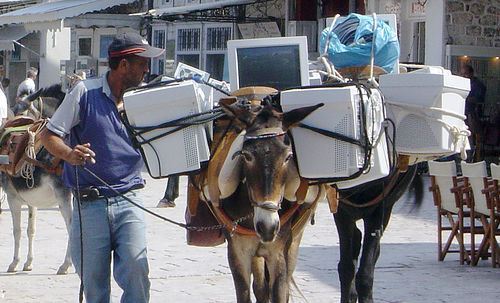
image

cc licensed ( BY NC SA ) flickr photo shared by Dave Sag

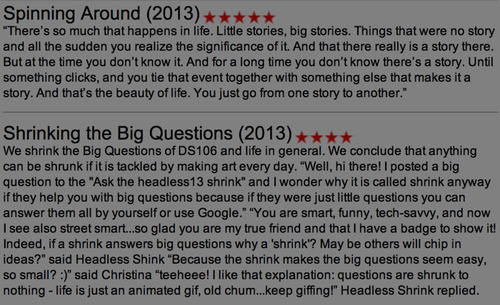
Here I jump the donkeys carrying computers, and evaluate ‘Shrinking the big questions’ and ‘Spinning around’ by answering the questions our weekly announcement set. I trust that my capacity for critical thinking and feedback going back a long career will suffice to do this task justice. There is little in DS106 material, beyond informal conversations and suggestions, that supports open participants in learning how to do this. Gardner Campbell suggested at Open VA recently that we could do worse than follow Wikipedia behavioural guidelines when working in the hashtag classroom. The decline of participation in the wikipedia project not withstanding, may be this is a good starting set of rules for online evaluation.[ At least until I write the definitive post on online feedback and why it will never work.]

My observations so far are that peer celebration is more the order of the day in DS106 than clear and specific feedback. The best feedback of this kind I have received has come from Alan Levine, who though not an instructor of Headless 13 is certainly an ‘elder’ active in our little community.

Let me be clear, I have nothing against peer celebration. I do believe we need ego boosting as well as notes for change and improvement.

The issue for me is that as we have light reciprocal relational links, I am unsure I know anyone well enough to be able to offer improvement feedback in a way that can be heard and may be wanted. I am also unclear about standards for assessing and evaluating, both my own work and that of others.

I am unsure what I can offer will be welcomed.

My initial observations of the norms operating our community suggests to me that whatever we do is a ‘pass’ and that better/worse are not comparators that it uses explicitly. For myself, Alan telling me ‘avoid x and try y instead’ helped me improve the quality of my output and that is why I engage with others to learn. I welcome more of that from others and whilst I have had great help when asking about a ‘how-to’, I have had less feedback evaluating my work against a set of standards than I might on a  for-credit classroom.

We do implicitly  evaluate work in DS106. This week we were asked to nominate somebody’s work to the Inspire website. I had already done so before reading the request – I nominated ‘Spinning Around’. The frame used is ‘nominate work you found inspirational’. This does give a clue as to evaluation norms in the community. Work is not better or worse, but sometimes people make art that inspires us. I can do that but that does not teach me (or does it?) how to make my own work better.

I make stuff that sucks, I am happy to have a go. However, my trying does not make it good art. It just makes me good at trying. External evaluation matters if I am to improve and learn beyond my own limitations.

Our radio team gelled behind the shared aim to produce a great show:

and I feel we succeeded. 

How did we evaluate each other’s work? We made sure we spent time relating and laughing together. Good old fashioned ‘let’s get to know each other a bit’ before we focus on the task at hand. We agreed working norms that would enable us to produce the show and stuck to them. 

We had plenty of opportunity to offer each other feedback. What I noticed was that it was never personal, it was always a measure against quality output. For example, I spent a few hours trying to clean up Jess’s audio. I did what I could, but was not happy with the output. Karen also offered specific feedback in the shape of ‘the echo is just too much, should we ask Jess to re-record?’. By then, Jess has already heard the edited audio and was on the case to re-record and learn Audacity. Another example was the show’s introduction. I had recorded an introduction early on, and was pretty chuffed with it. Of course, the introduction had been done in isolation of the show as it evolved. I woke up one morning, to find lots of Tweets that essentially said ‘introduction is too long, need to re-record or drop from show’. After picking up my hurt ego off the floor – not really – I tweeted that I thought we should not drop it as the show needed an introduction and  that I would re-record. I was ruthless in editing the script, did it again and it was all the better for it. 

It has also been easy to keep on working together and offering feedback on each other’s output. We are now even evaluating our own work as we send it out – I can hear when the sound is not right, I can offer my evaluation and then we use if usable and short of time or just redo if we can. We got our evaluation process streamlined and it has enabled us to produce another episode of our show for Halloween. Just because we wanted to.

Below I take a stab at answering the evaluation questions exactly as week 9 announcement requests. I am doing this to encourage us all to do more realistic and specific evaluation as well as keep on with peer celebration just because we are motivated to create something each day. This is awesome.

What would make it even more awesome, for me at least, it to have us engage more on evaluating the quality of what we are producing and critically engaging with criteria for evaluation – what can I do 

  • less of
  • more of
  • or continue doing

to make my DS106 work better each day?

I believe the weekly announcement suggest we should be engaging on this conversation beyond the undeniable fact that our motivation to keep making stuff is inspirational and exercises the creative muscle.

Criteria for audio and the extent to which Shrinking the big Questions (SBQ) and Spinning Around (SA) met them

Quality of audio sound – e.g. Is the volume appropriate? Are the levels even? Is the sound clear, and free of noises not needed (e.g. mouse clicks, background noise)?

To my untrained ear SA had the best sound quality of all the shows. I listened to it over and over and enjoyed its crisp sound each time. There was a flow to the sound, silences were just long enough not too long or too short. The whole thing cohered to give the feel of one song with many voices with each voice clearly heard. 

SBQ struggled with getting the noise even, when I heard the whole thing at the European Premiere I noticed there were extraneous noises in the different segments, at some point you can hear somebody tapping at a keyboard. We each mixed our own segments, where SA had one person mixing from the raw sound. What would make it better? I learnt that much care has to be taken in the quality of that raw data, there is only so much you can do when you edit something – this was so clear with the DS106 controversy segment. The second recording, made with a higher quality microphone, was of far higher quality and easier to edit than the first. 

Quality of audio editing – use of effects, transitions, are the edits clean?

I need to learn more how to fade in and out. I learnt, in looking at how others edited, that I cut in/out in too sharp and abrupt a manner. I do not understand enough about the physics of sound to manipulate in any meaningful way beyond trial and error. I also need to learn more about the mechanics of microphones and fine editing.

We were saved in SBQ by our overall editor having a self-confessed perfectionistic streak. Credit goes to her for going through many a tutorial to learn ways to improve our sound. Talky Tina and Christina know more about sound clearly, and though I have not asked Karen, I think their sections will have given our sound editor much less hassle than say mine.

I am now learning to use effects more easily, music for transitions, and smoothing out segments. SA uses effects and transitions in such a way that there is not sense of separate sections – it all blends easily to my ear and with so many voices I am inspired by the editing and the quality of the raw sounds the group produced. 

Use of sound effects- How are they used? Is it effective?

Yes, I think we both used sound effects effectively. I did not use them in my section, and their lack shows. I ran out of time to add them in and I had not yet learnt how to do it well – so decided to go without. SA used repetition staggered to great effect. Reading the lyrics of the song spoken just after the the song is played – very powerful. Of note in SBQ are the sound effects on the cooking section of the show and on the meaning of life section – they are clear, appropriate and timely. 

Use of music- how is it used? Is it effective or distracting?

Music added in SBQ worked well. I did not use music for same reason as above – not enough knowledge of how to mix. Music added by Karen and Talky Tina really helped bring the show together and taught me how important it was to include it so as to keep attention of listeners. I need to work on this and SA were an example of best practice in the use of music.

Does the show have a structure? Is it cohesive or does it feel stitched together?

SBQ could have felt stitched together, and may be it does a little. Talky Tina’s interventions throughout create a thread, the bumpers and commercials do also – I did not see the point of them at the start of audio weeks – and references to other segments within the show help the flow.

However, our topics and styles were very different and had the team work not been as good as it was, the knitting together may have failed.

Interestingly, SA’s editor Rochelle also felt that their approaches were different and an approach was needed to cohere a show. Perhaps this is the craft of editing? SA tackled the coherence issue with music that flowed through the whole show. I loved the one song SA used, but the whole thing would have been lost on somebody who may be did not like the song as it was repeated over and over again. A high risk strategy for coherence that paid off for my untrained ear at least. I would have like more narrative about the ideas and the making of it – some of what came through in the blog post could have made another 15 minutes of the show and may have given us a coherent analytical message after the emotional and on-linear message had been heard.

Does it tell a story effectively? Is there a sense of drama, unknown? Does it draw you in to listen?

SA absolutely and I could not think of anything that would enhance it. SBQ was not about drama but humour and thought provoking ideas, it did draw me in. I chose to listen to it for fun and each time I hear it I smile. Yes it tells a story effectively but it is too long.

If i were thinking of it a a ‘proper’ radio show I would structure it as 10 minute episodes each tackling only one question. Music and other programming would be the main focus, and SBQ would be short ‘funny, absurd, and very DS106!’ morsels spread through the day.

If you would rate this radio show, how many stars out of five would you give to the show

I answer this question with a little help from Photoshop and Hackssarus.

image

I worry about upsetting my team by giving us one less star, I worry about the other teams thinking I chose this show because I liked it, but that may be I did not like them as much. I worry about offending both teams I talk about here with some of my suggestions for improvement. It is hard to offer meaningful evaluation to others online, I find it easier to self-evaluate. But unless I hear external voices, I worry I am  in a digital echo chamber not learning new things just hearing what I want to hear.

What has helped the process is the closeness of our small group work and getting to know people. If we understand people’s motivation, it makes it easier to offer feedback that can be heard. Just because I want improvement feedback, and because DS106 announcements suggest we should learn how to evaluate ourselves and others effectively it does not mean that everyone involved in DS106 Headless 13 wants evaluation.

Some may just want a space make art and not a space to be evaluated. 

I need to tackle the issue of assessing others’ work.

  • How can criteria for assessment be agreed online?
  • How can we teach online participants to assess each other with rigour that comes out of engaging with the issue of setting clear standards?

Why? Selfishly, if I want to use this kind of model to support my own students then we need to be able to assess each other’s work to Masters standards and do so in a public setting. Self-managed learning offers a set of procedures that may help, but the group process and norm setting issues remain.

This feels an insurmountable challenge to introducing open education in my environment right now. I hope to learn more about effective ways to evaluate my own work and that of others as we move to the final (final?) stretch of this DS106 Headless. 

‘Stealing’ from Phonar…again!

I stayed up and made notes on the SoundCloud!

A key takeaway for me is that you cannot produce the artefact unless you know the narrative and the characters – if you do not, how would you know what to photograph?

Here is the Storify with notes from other students. I like to get some clear input and not always have to create all learning experientially from scratch.I found this helpful to ground in realistic assessment the hype of making art. We need to do our research and critically assess the impact our work can have. 

The Decline of Wikipedia: Even As More People Than Ever Rely on It, Fewer People Create It | MIT Technology Review

Do not attempt if distracted – Shrinking the big questions

And if you want to make sense of this post you need to read my previous post and most importantly – have listened to the show!

I want to start winding down audio weeks 7 and 8 so that I can start week 9 of DS106. I am feeling quite overwhelmed – like one of those situations when I ask my students to fill in feedback forms too soon after a class.

I know that they need time to process, but sometimes I do not have the choice to let them reflect before feedback as I have to follow the procedures set up by the place I may be teaching in.

Nobody is asking me to follow procedure on DS106 Headless 13. I am asking myself to follow procedure – complete weeks 7 and 8 before you move on to week 9. The reality is I will not complete for weeks as the list of audio to dos grows. Some might say, I will never ‘complete’ as DS106 is #4life. The rhetoric being what it is, I like the feeling of getting to the end of the weekly announcement – done!

So, as my true friend Talky Tina might say, here we go.

My previous post offered highlights of the work I did and posted a link to our radio show which for me was the highlight. Here, I want to complete audio weeks by following procedure to the letter.

I want to offer a personal ‘reflection upon [my] contribution to the radio show and to [my] assessment of the group process’ as requested in the weekly announcement.

I will write a more theoretical assessment of group process and how I see the differences between my current practice when facilitating groups and teams and what I have learnt here elsewhere. Here I want to use the questions posed in the announcement as a way to start a personal reflection on what the making of my first radio show has meant to me. For once in my life, I will do as I am told. Mum would be proud. 

How did your group go about choosing a theme and organising itself?
The idea for the programme came to me early on when talking with Talky Tina and Christina Hendricks here on this blog. The three of us talked about the meaning of life, about why shrinks are called shrinks and Talky said:
“Well, hi there! I posted a big question to the “Ask the headless13 shrink” and I wonder why it is called shrink anyway if they help you with big questions/ because if they were just little questions you can answer them all by yourself or use Google.”
This is how the theme was chosen. I love Frasier’s talk show, and had the idea we might do a call-in show with Talky and me shrinking the big questions of life. This was early on in the Headless 13 and when we had to make our first radio bumpers, I made bumpers for a show that did not exist other than as a vague notion in my head. My favourite was the one I started this post with, but we did not use it in the end. 

When it came to forming groups, I posted what I knew about the idea on our shared google doc and suggested the idea for the show. I think I invited a few people I felt I knew a little better to join the group, some did and some did not. As time went on some people asked to join the group and we welcomed everyone. We had a last minute joiner to help out with one element of the show. The theme was jointly chosen by Tina, Christina and me. But it evolved as we talked about the show and we included more people in our group. 

The organising was also quite organic. For example, I got quite bored typing everyvbody’s twitter handles and sent a Tweet asking if it was possible to do something about this, I did not know enough about Twitter to work out how to get a team twitter handle. Christina saw it, created the @talkyteam account and told us what we needed to do (open a Tweetdeck column and follow @talkyteam) to have the tweets turn up on our stream. it worked so well. It helped the organising but also the sense of identity of us as a team. The rest was easy – hangouts to talk, google docs to create a shared outline and talk asynch, and my Dropbox with a TalkyTeam shared folder to store stuff. A lovely touch here came from Talky Tina. As the dropbox started to get full of stuff and very unorganised, I woke up one morning to find that our DS106 doll has a penchant for tidiness – she had created her own little TalkyTina sub-folder to put her recordings in. Clearly, I took her lead and swiftly tidied up the Dropbox creating a sub-folder for each of us and one for introduction and close materials. 

We were all really motivated to make the show and enjoying the process.

This showed in the process of organisation and theme selection. Karen Young said on the live premiere that one of the things that made it work in her view was that we allowed everyone to play to their strengths and contribute rather than try to force an idea through. She is right. Once we had the shell of the programme, the idea that we were going to shrink the big questions, we put all the information on the Google doc (such as questions the Headless Shrink had been asked, ideas for style, examples of podcasts or shows that we might emulate) and people took all this and shaped it to their own visions. There was no micro-management of content, within the constraints of time and overall theme, each person selected a ‘question’ and wrote their own script.

I loved Radio-lab, so I tried to shape my piece in that way. The Cooking Show was Karen’s idea and she used the philosophy and meaning of life idea to create her hilarious and nuanced segment. Christina decided to play at shrinking the philosopher’s biggest question (what is the meaning of life?) and created a really thoughtful piece to explore this question. Jess’s numerology was all Jess. She took the question ‘what is DS106 and why DS?’ which we had been asked anonymously when I pleaded for questions on Twitter, and made it her own. I remembered about the DS107 rebellion, asked Jim Groom and he not only directed us to News on the March but also recorded a Soundcloud for us to use. The script Jess came up with was hilarious and really appealed to the geek in me, as a Dr Who fan the notion that 106 lost Dr Who episodes had been found appealed to me hugely. As did the idea that her Galaxy phone would have the answers. Rhonda was asked by Karen to join in to be the second cook on the cooking show part of the show, she recorded her parts and was happy to work with what we had to help us get to the end. She was very gracious and supportive – getting a new group member half way through the process would not have been so easy had it been anybody else. 

Talky Tina deserves a paragraph all her own. She rocks! She attended hangouts, created her own hangouts and made art as she was waiting all on her own at a hangout she created whilst we were all talking elsewhere. She was in her travelling container most of the time and yet had a good enough signal to talk with us and produce impeccable recordings of anything we asked her to do. She was a true professional actor, as well as giving us really useful technical tips as we wrestled Audacity and GarageBand. Alan Levine asked at the premiere if we thought she was real. Well, Alan, I can only say that she is more real to me than many ‘real’ Ds106ers that are lacking in art and in completing weekly announcements. She knows her stuff, she helps her team mates, she never lets her ego get in the way of opening night, and she gives us inspirational art and tips to boot. What is not real about that? The effort that goes into making Talky Tina an integral part of DS106 is something I am full of admiration for and support in any way I can. She rocks! And i just realised I have been doing week 9 stuff all along in supporting the narrative around our beloved true friend Talky. 


What was the easiest/hardest part of working as a group?

The easiest was working with the people who formed the team, we all had a sense of shared responsibility and a genuine desire to make something good. We all did the best we could to put our egos to one side and be in service of the craft. It was a joy to see something beyond any initial idea I may have had emerge as we engaged openly and honestly. 

The hardest for me was the time difference. I felt at times excluded from conversations that went on as I slept. This ended up working in our favour as relationships matured because it meant that we never slept as a team. Jess and I got stuff done as others slept and Christina, Tina, Karen and Rhonda worked whilst we slept. Seamless work flow with Bossy Young sending us our tasks as deadlines approached and we loved her for that!

How did you decide upon your own contribution to the show — did you pick something in your comfort zone or did you decide to push yourself in a new direction?

It was all a new direction. I have never done audio or radio before DS106 and have had negative learning experiences working with groups of strangers over the web on study projects. I did not have high expectations and, if I am honest, I was dreading the group work. In fact the only person to drop out of the group early on, was one of the people I worked with on a previous online project that had not gone well – I wonder if she had concerns about putting herself in that type of learning situation again after our previous experience. On that project for the Open University we found ourselves the only two people having to work on a project not of our choosing for assessment on a Masters Module with no community or tutor support. That experience left me feeling negative about virtual group work – and reinforced a belief that effective team work requires face to face leadership. A view I have since changed. I did have to push myself hard in a new direction to stay open to what DS106 radio group work would bring. Christina helped a great deal, as she was so positive about her previous experience.  

How do you feel your show holds together as a whole? Do you feel like you achieved your goals in terms of the story your group set out to tell? 

Yes, we achieved our goals.

Our goals were emerging and not fixed, so it is hard to say we achieved anything. The show took shape and we were all part of it taking shape. My contribution was more the big picture, staying on the theme of shrinking big questions, and pulling together threads as I saw them emerge online. Others contributed attention to detail, yet others a sense of humour, interesting insights, and all contributed a willingness to engage and share.

My sense is that what holds the show together is Tina’s inquiry into the big questions we chose to shrink. Her interventions throughout and her opening and closing the show. The actual questions we chose could easily become shows in and of themselves – ‘Shrinking with cooking’ with Karen and Rhonda- domestic goddesses, ‘Tina and Christina shrink philosophy’, ‘Jess shrinks the 106 conspiracy’, and ‘This The Headless shrink, I’m listening…’ (apologies to Frasier). 

I would like to turn this question on its head and say that it is amazing that such disparate ideas held together at all. The glue was Talky Tina and the good faith with which we engaged in the process together. As far as the quality of the radio show outside our learning experience – I do not think it holds together at all outside the ongoing narrative of DS106. A martian (or a zombie?) coming to it would not make much sense of it. The whole show is just a story that makes sense in the context of DS106 Headless 13 and to those of us participating in it. For those outside, I fear,  it would be little more than in-jokes and a Talking Doll that asks too many questions. In comparing this with what others have done, I see that radio needs to be standalone to have wide appeal. I also see that each short section needs to be standalone as a listener’s attention span is short and goes back and forth. 

My intention was to create something that would make us smile and would embody the nature of DS106. Does the show do this? Yes, I think it does. What comes through is how openly we engaged, and how we have developed our relationships with each other and outside the DS106 community. We are already talking about the next Talky Team assignment and are considering a Zombie Radio Show or station for Twitter Vs Zombies next round. Karen puts it best – we keep listening to what we have done and laughing at our own jokes, we enjoy the output we have created. For myself, I keep listening and finding subtle links between segments that we never planned as a group but that we each felt responsible to include in order for the whole to hold together. If any one of us had wanted to run away with their own ego and forget about the show as a whole, these subtle connections between segments would not have been there and the show would have been much poorer as result.  

What do you think people will say about it?

I have collected a couple of Tweets from people about the show. There were many more but I am out of time (I wanted to collect them all and do a Storify with them, but not right now).

The overall sense I have about what people are saying is that it has a lot of ideas in it, a lot of jokes and witty lines that perhaps can most easily be understood by those who made the show and other DS106ers, some interesting ideas about stories and life and some damn good commercials.  

You’ve worked pretty intensively with audio now for several weeks of DS106 — describe what that process has been like. 

I never gave audio a thought. I was surprised to see it have such extensive billing on the syllabus. And was not particularly looking forward to it. The process has been one of discovery. I do not listen to radio or music for reasons beyond the scope of this post, so it was not as a listener that I had any interest. I started to get interested out of necessity and realised that there was something I enjoyed about voice and audio. The last few weeks have been like finding a treasure trove with amazing trinkets from another planet. I have a sense of a precious mystery, as I ask myself what makes audio work. I am learning from listening to DS106 Radio and now even listening to my local radio station and beginning to understand a new language. 

Have you changed your feeling towards audio?  

I had no feeling for audio before, I am learning to love it.

When you started with this section of the class, what did you think it would be like and how did the experience measure up?

I thought it would be a chore to complete, but that I might learn something new. I did not have any expectations beyond learning how to tell a story with audio. So the experience had low expectations to measure up against. It seems meaningless and cliched to say it has offered learning beyond my expectations. What I have gained and am still gaining is much more precious than that – I feel like I am visiting a new country, one I do not understand well but am fascinated by. It reminds me of how i felt when I went to Japan. I loved it, it felt very special but I was also so very aware that I did not understand it. A great gift. Now, I had better get on with my audio to do list and start working on week 9. 

For a web begun, god sends thread...

Thank you Seth, for this lovely saying.

I hope God will send me thread as I sit to write my 2 week reflection post again. I spent all morning putting it together and did not save my work. I have had the opportunity to connect with the ephemeral nature of the web and with the ill-will of a mind full of unmet expectations. No, Tumblr does not auto-save drafts. Just breathing and noticing my attachment to completion, as I start again and keep saving every sentence.

I start again with half an idea of how I may put this together with the time I have left before I need to move on to the next thing. Have a tantrum? Write a stinking letter to Tumblr and meet them up the stairs?

i will just get on with my reflections for weeks 7 and 8 and write them down for a second time – may be with fewer links and shorter than the previous version, but reflections anyway.

Key insights:

  • Daily creates help me get into the habit of making stuff but do not meet any real quality criteria. I have done many and most I have forgotten. They fulfil a need in the moment but have no permanence
  • Assignments give me more time to wok on something and get it to a standard I assess to be ‘good enough’ – I prefer to work this way
  • These last 2 weeks have taught me much and left much work in progress
  • The highlight of the 2 weeks has been the radio show and whilst you can listen to the show below, i will be writing about my learning from it separately as there is much both practical and theoretical I want to unpack from the project. 

Of all the daily creates these last two weeks I like this one best,

image

It was done in response to TDC643 draw the internet. I like it because it started as a screenshot of a film I made for the same daily create and it ended up as I played with photoshop as something that emerged – just like the web does each day we connect with it. 

As far as audio my favourite was the create I made up for myself visiting the Phonar course.

Of the assignments my favourites are 2:

Both challenged me in different ways, one expanded my mental models of the value of audio, the other helped me expand my technical skills using GarageBand and iMovie.

I said that these 2 weeks have left me in flux with work in progress, I have begun a web and I hope God will send thread in the shape of time to complete this work and start week 9 before the end of week 9!

Here is the list:

  • Pictures for your ears podcast – editing a joint effort between two hashtag classrooms: DS106 and Phonar. I have been inspired by my interviews so far and hope a regular slot on DS106 radio may emerge
  • ColinPods – i have started a new blog for audio photos. I love the idea and want to do many more
  • Talky Team’s radio project blog post here – my personal experience
  • Keep getting better at all the tools as I am still limited by my lack of skill in bringing about the ideas I imagine
  • A ‘serious’ blog post about team process and facilitation of virtual teams – this project experience has made me question much of the received wisdom I work from when I facilitate executive teams in the workplace
  • I want to do a podcast shrinking another big question ‘is DS106 addictive?’ I have asked another Headless13 participant if I can use a conversation we recorded a while back as a starting point

What is the most important practical tip I have learnt this week? You guessed it – save your [add your own expletive] drafts regularly. The biggest insight? I am learning to be less about explanation and more about imagination.

Design safari 2 with Ds-ina

Yes, it is!

So this weekend I had intended to work on the radio show, perfect my audio voice and re-do my work over and over to get it ‘perfect’ whatever that means. Instead I went on another design safari with Ds-ina. She wrote a blog post that ended with:

It took me over a week to finish this blog post, and probably it’s far too long for anyone to read through the whole thing. 

Well, Ds-ina you were wrong; not only did I get to the end but read it more than once and followed up your links as you had explored different stuff from me though we both started from the same document. I liked the fact that your post was sharing personal learning, reflecting on personal struggle and not trying to establish the rights and wrongs of design. I too struggled with many new concepts and challenges to deeply held views on design week. It is something I want to keep learning about – may be next time I do DS106? Did I just write that? I decided to strike while the iron was hot and just go on a new design safari with Ds-ina. What follows are my reflections from her post and new thoughts it led me to explore.

I started with this comment as the post explored colour and its use in design: 

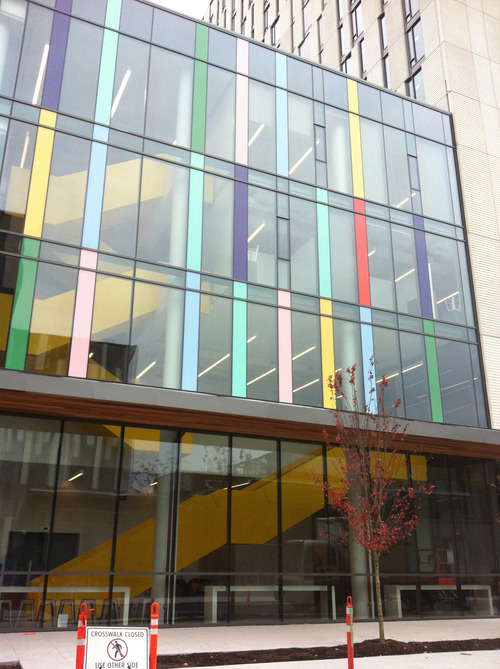
Is this a good use of colour? Honestly, I have no idea. Are the colours used complementary in some way? Should they be? Why are these particular colours used, and why are some colours on top of others—what guided that choice? No clue. All I can go by is what seems pleasing to me, and I do like this one. I think the contrast of the colour and the dark-ish glass is nice, and the colours are spaced in a way that seems balanced.

image

This spoke to me at many levels. It suggested to me it is one thing to notice design elements and another to feel able to say if something is good design. This resonates strongly with my own explorations. Ultimately I too went back to a visceral like/don’t like criterion which is what Donald Norman suggests design is about. He says a small percentage of what we choose as good design is reflective in nature (i.e. we choose  consciously in line with our values) but the majority is visceral, behavioural and unconscious. Good design makes us happy. So, as we see something pleasing, a surge of dopamine hits the brain and generates positive emotion. We cannot explain it with language, but we feel it. 

Norman illustrates this in many ways ( the short video is a design safari itself – and great fun to watch) but my favourite example is this:

image

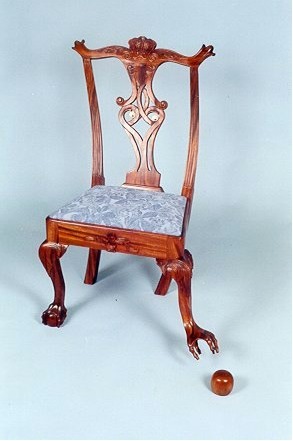
This is Jake Cress’s chair with flaw.

It comes with a short story. This poor little chair knows it is flawed and it is working hard at trying to fix itself. Norman says that what is interesting about this is that we believe the story and are emotionally affected by the object. We like it. I have linked to Jake Cress’s website (click on the photo) – worth a visit if quirky furniture that tells story is your thing. 

This connected for me with the video by Paul Zak during the initial weeks of DS106. There we learnt that increased production of cortisol and oxytocin are found when stories are told that fit Fraytag’s dramatic arc – exposition, rising action, climax, falling action and denouement – and that this makes us behave in ways we may not have chosen to behave before we heard the story. Zak proposes that stories are changing our brain chemistry. In the same way that Norman says our brain chemistry is changed by good design. 

It is a difficult job then for any budding designer to determine how to make people happy so that they like their designs. As I continued to read Ds-ina’s post  I began to see a pattern. Designers are trying to create conscious heuristics or principles that may lead to people’s happiness ( or their emotions being affected in some way)

Ds-ina in her post explores symmetry for example. She quotes this article, 

Symmetrical balance occurs when the weight of a composition is evenly distributed around a central vertical or horizontal axis. Under normal circumstances it assumes identical forms on both sides of the axis. When symmetry occurs with similar, but not identical, forms it is called approximate symmetry.

I had been struggling with the idea of approximate symmetry, but she shows us a photo that explains it beautifully. 

image

People, but not of the same sex or doing the same action! I now get approximate symmetry. What this has done is given a heuristic to understand why I may have a positive emotional reaction – I like it – to this sign. There are many signs that have useful purposes, such as helping us to recycle more, and design principles may or may not be applied to these. Ds-ina’s post goes on to explore some objects and signs as she continues her design safari around her university campus. I encourage you to read her post for a clear and well supported explanation of many principles we covered in design week. I particularly liked her examples about minimalist principles and asymmetrical balance, which for me until I read her post, had been a contradiction in terms. 

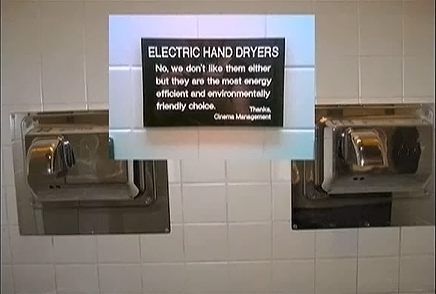
As I went further on safari with Ds-ina, it put me in mind of the idea of emotionally intelligent signs. The notion that we are more likely to take action on a sign that appeals to our emotions and particularly signs that are empathetic to our experience such as this one, 

image

This sign singlehandedly changed my view of electric hand dryers a few years ago.

I then spend several hours watching Objectified again and again. I have mentioned this film in a previous post. It really challenged my views about what makes good design. It goes beyond notions of aesthetics and brain chemistry and makes us stop to think about the intent of design. it suggests that we need to think systemically not individually about design; that non-disposability, and longevity matter; that there is a reality to be faced about how objects that have been thoughtfully designed are just landfill fodder for the future. Many examples and images later, that tell a story of waste and consumption, I am ready to sit up and listen to the suggestion that what Norman calls the reflective level of good design may need much more attention that we give it. Both in object design and in designing our personal cyberinfrastructure. 

I kept going back to Ds-ina’s post and noticing the discomfort she expresses with evaluative criteria that are from the purely personal realm. The whole safari seems a quest for more impersonal criteria against which  design could be judged. I found myself in the same place during design week. I was happy to come back to ‘art in the brain’ as a foundational principle, but something kept nagging at me too. So I explored further the ideas in the film as I felt that an answer might lie beyond the personal and my love for creating ephemeral artefacts. 

I found the seed of an answer in Tim Brown from IDEO talking about design thinking.

I can only say ‘watch it, now!’ But here is his view of what design has become. From,

systems thinkers who were reinventing the world, to a priesthood of folks in black turtlenecks and designer glasses working on small things. As our industrial society matured, so design became a profession and it focused on an ever smaller canvas until it came to stand for aesthetics, image and fashion.

In the world of digital storytelling I guess this equates to using our shiny digital toys to make stuff look good without a thought for the crafting of the story and its place in the wider world. I think that these ideas challenge us to think beyond individual creativity and look systemically to the intent of the storyteller and the actions our stories encourage. 

His answer? Moving away from design and towards design thinking.  He calls for ‘a shift to local, collaborative, participatory design thinking. ’ It suggests a set of design principles grounded not in psychology, not in individual aesthetics, but in community and what David Kelley calls a common ethos of empathy for the consumer. it uses rapid prototyping as a tool that puts potential ideas into the hands of users and gets users to assess value. Kelley says ‘it is not rocket science, it is just empathetic to people’. This is the approach that gave us Apple’s original designs, they worked with Steve Jobs in the early days. This to me has hope. It is defined as ‘human-centered design’. It encourages creative confidence as the ability to ‘to fail often, to succeed sooner’ and as the ability to come up with ideas and having the courage to try them out. This implies to me that what we try does not always succeed, that we should assess this according to an external criteria of how others engage with our designs, and that we need the courage to remove and delete what does not work, and try again. In turn, this requires that we look in the mirror and question our givens – and just why do we like that? The design thinking approach further encourages us to ask: Should we like that? What is the larger purpose that my individual creativity is serving? For some the answer is in social change as in the example of Southwark Circles as a new way to care for the old, for others about open education and using it to teach this approach to design. Yet others want to focus on younger people and how to support them in this kind of thinking. 

If we change brain chemistry and the way people act by the stories we tell, then may be we have a responsibility to press pause and question our intent as storytellers. The wider purposes, our responsibilities as storytellers to ourselves, our communities and the wider systems we belong cannot be ignored when looking at the issue of design principles in digital storytelling. Jonathan Worth may be on to something when he says we have to teach the ‘gravity of the role of the storyteller’. Perhaps there is space to add a week on this topic in future runs of DS106?

I have learnt much and much remains to be learnt.

I take away the need to hold the tension of opposing views as the frontier where new ideas are born and how tough it is to do that without the mind grasping for simple solutions. Thanks, Christina for taking me on such an insightful safari and encouraging me do a second one of my own that has led to deeper insights.

The craft is in the silence

Take a movie clip and create foley sounds for it, do it all in one take.

Seemed an easy enough assignment. I set out to read and listen all the recommendations about Foley artists. The more I watched, listened and read the more I frowned. I could not understand why I should do it the way it was being suggested. Advise from fellow ds106ers did not seem to help. yes, I knew I could redefine the assignment and yes I knew that making sound effects was a fun and creative activity. I loved watching foley artists at work and really appreciate the efforts they go to to get just the right effect. Why one take? I kept asking. Why not use ready made sounds and use an editor? I kept talking to my fellow participants and went to bed frowning.

I woke up with an aha! moment. I said to Rochelle on Google plus:

This morning I woke up and I got my why :o) it is like acting and improvisation of course! I could not fathom why foley artists do it the way they do it. Now I see that (I think) if they did what I suggested yesterday, get sounds and add on garage band then there would be no performance. Ahhhh ! And that transfers through to the sounds. I was wrong and thanks for helping me see it :o) I will do my clip and perform my sounds in the kitchen this morning. Yes, mad mad mad….btw  your podcast was really helpful on the how. Reflecting on the how helped me see the why.

I did as I said and here is the result. We were not asked to create the film clip with the sounds, but I could not resist:

I cannot even begin to make an exhaustive list of what I learnt.

Yes, the performance to the film makes all the difference and hence you have to do it all in one take because there is a movement flow that adds realism to the sound effects. Whilst it may be okay to adapt the assignment, if had done that I would have learnt only how to use the editor and not about the depths that exist in sound and the continuity of sound. The silence is full of sound and it matters – I am not the first to say this, but this morning I experienced it. 

May be this is the appeal of radio, working with sound, music and the ‘noisy silence’. The meanings it carries are just below awareness but are there. A pause, a hesitation, a word mispronounced say something to the listener. What a gift to have learnt to listen a little better to silence this morning. i am glad I chose to do as I was told for once. 

Some details of how the video above came to be:

  • download and use Mpeg Streamclip to select the 30 seconds for the assignment
  • save as video only with not audio
  • used this tutorial to learn that GarageBand would do movie and sound editing – I was not up for iMovie yet
  • listed all the sound in my clip
  • rehearsed in my kitchen – learnt that I had to flow with the clip as if I were in the cage with the lion
  • used my iPhone on a tripod for the recording – no extras
  • emailed me the sounds
  • opened GarageBand and imported my sound file and my video clip
  • made sure it all lined up – it as pretty seamless. The only issue was I had to copy one sound to get better flow
  • I then decided to get experimental and add music to the sounds
  • found something appropriate in Jamendo 
  • I thought I wanted to do a bumper for Colin The Dog Productions and set to it. Colin obliged with a perfectly executed bark and Quicktime recorded sounds well enough
  • I was so happy with the result I did add the cheering crowds from Garageband sounds
  • had more layers in Garageband than I have dared to have until today. I even started to have sounds come from left/right for impact. I staggered sounds for smoother transitions. I tracked sound and increased and decreased volume depending on the impact I wanted. The fun ending was the hardest to pull off. 
  • upload to YouTube
  • embed here
  • revisited the track on its own to upload to Soundcloud, made sure it was 30 seconds and tagged as requested. I really do not have a clue why, I am expecting something big to happen with all that tagging

And an assignment that I was planning to get done in five minutes has taken days, rehearsals, water all over my kitchen, and profound learning about sound and its relationship with silence. Thank you to all those who engaged in the dialogue to help me learn. My favourite sound has to be my tiger.  I do a mean tiger don’t I?

Copyright © 2026 DS106 on the couch

Theme by Anders NorenUp ↑