Category: Uncategorized

Been playing with Shadow Puppet as more than just short commentary on photos. I re-did my design safari photos as a Shadow Puppet story. I had some issues uploaded the larger file but Carl now has released a new version of the software that allowed me to create, upload and embed the story easily. 

It is a really elegant and useful solution to putting audio and photos together – can be used to create educational presentations very easily now that the 4 minute upload limit is no longer a problem. 

Reading movies – The Matrix audio only

I have followed the same idea as with the video only part of the scene and put the audio on Soundcloud for anyone to add to. I read somewhere that this is thought to be the best acted scene in the whole of the movie. This has to be in no small part due to the quality of the sound – it is like an audio story in itself even without the powerful visual input. Like an opera dialogue of sound between good and evil! Get me the movie critic after reading the first scene in my life…This could become an addiction like animated gifs if I am not careful. Enjoy!

Reading silent movie scene – The Matrix

I created a Vialogue with the scene and my comments in case other Matrix fans may want to play and add observations to the scene as per our week 10 assignment. 

In Italian there is an expression ‘troppo buono’ meaning an experience is just so good that it is almost ‘too good’. Well, moving on to video weeks is almost too good – so much to learn and so much fun.

Week 10 – ‘New’ You Tube Genre

Well, it is not new. It is the type of thing that first got me interested in digital stories: Stick people animations generally and the stick man fighting the computer in some way

My example is a classic I first saw many years ago – I have not had a chance to research its origin. I have added it  into the shared genre document for DS106. A trip down memory lane. Update: I asked some question on Google Plus and hat tip to Kevin Hodgson who found me the original video. I can ow report that the author is Alan Becker and that he has other animation on the same theme and more on his own site. You can also read the story and how the video has had millions of viewing worldwide. Alan has even made a set of tutorials to help us learn how to make the animations and I have put them on my list of extra DS106 jobs to do after Headless 13 finishes. 

My justification for this as a unique genre? I used a quantity criterion, there are many of these in You Tube and all you need to do is search for ‘stick animation’. If you make it more specific ‘stykz animation’ then you get stuff generated with Stykz software. I like the simplicity and the creativity that emerges from the constraint of the medium. 

Week 9 Evaluation – self and others

We are asked to evaluate our own radio show and one other.This feels an important element of learning on DS106, but harder to offer and get in this Headless version of the course than it might be if we were doing this course for credit. Alan Levine reflects on the difficulty of giving feedback at the right level in a hashtag classroom. He concludes his post on this with some interesting questions:

Can a community fill some of that feedback role so an instructor does not max out? Or in what ways can the class itself pick up its own feedback circle without it being a thing being done just for the credits?

I think this area that merits a thoughtful response – and the best way to do that is to jump in and offer some feedback, as the week 9 assignment asks me to do. I will post later on what I believe to be a methodological approach that may offer an answer – briefly, I believe that Self Managed Learning offers a potential model. I have been teaching using this model face-to-face for 20 years and believe it would translate to the hashtag classroom well with few adaptations.

A core issue on this Headless 13 course is that as it is not done for credit – it is permissible to do as much or as little as anyone wants and there are no consequences for non-compliance with assignments . Furthermore, what is delivered meets self-set criteria not externally or collaboratively set by the cohort. The issue of how we learn, how we reach understanding and how we meet quality criteria for learning is complex and many-fold involving a 4 point diagram that includes content, teacher, learner and context where learning happens. This further depends on personal beliefs about how these elements interact. Is learning social or personal or both? do we subscribe to the conduit metaphor of knowledge or to a metaphor of learning as participation? These will be a topic for another post. 
image

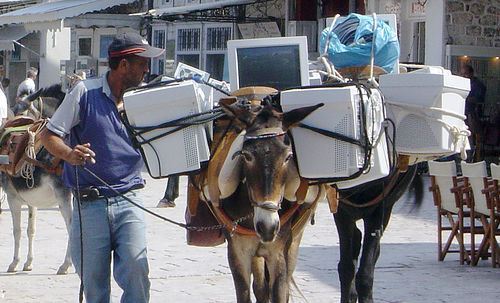
cc licensed ( BY NC SA ) flickr photo shared by Dave Sag

Here I jump the donkeys carrying computers, and evaluate ‘Shrinking the big questions’ and ‘Spinning around’ by answering the questions our weekly announcement set. I trust that my capacity for critical thinking and feedback going back a long career will suffice to do this task justice. There is little in DS106 material, beyond informal conversations and suggestions, that supports open participants in learning how to do this. Gardner Campbell suggested at Open VA recently that we could do worse than follow Wikipedia behavioural guidelines when working in the hashtag classroom. The decline of participation in the wikipedia project not withstanding, may be this is a good starting set of rules for online evaluation.[ At least until I write the definitive post on online feedback and why it will never work.]

My observations so far are that peer celebration is more the order of the day in DS106 than clear and specific feedback. The best feedback of this kind I have received has come from Alan Levine, who though not an instructor of Headless 13 is certainly an ‘elder’ active in our little community.

Let me be clear, I have nothing against peer celebration. I do believe we need ego boosting as well as notes for change and improvement.

The issue for me is that as we have light reciprocal relational links, I am unsure I know anyone well enough to be able to offer improvement feedback in a way that can be heard and may be wanted. I am also unclear about standards for assessing and evaluating, both my own work and that of others.

I am unsure what I can offer will be welcomed.

My initial observations of the norms operating our community suggests to me that whatever we do is a ‘pass’ and that better/worse are not comparators that it uses explicitly. For myself, Alan telling me ‘avoid x and try y instead’ helped me improve the quality of my output and that is why I engage with others to learn. I welcome more of that from others and whilst I have had great help when asking about a ‘how-to’, I have had less feedback evaluating my work against a set of standards than I might on a  for-credit classroom.

We do implicitly  evaluate work in DS106. This week we were asked to nominate somebody’s work to the Inspire website. I had already done so before reading the request – I nominated ‘Spinning Around’. The frame used is ‘nominate work you found inspirational’. This does give a clue as to evaluation norms in the community. Work is not better or worse, but sometimes people make art that inspires us. I can do that but that does not teach me (or does it?) how to make my own work better.

I make stuff that sucks, I am happy to have a go. However, my trying does not make it good art. It just makes me good at trying. External evaluation matters if I am to improve and learn beyond my own limitations.

Our radio team gelled behind the shared aim to produce a great show:

and I feel we succeeded. 

How did we evaluate each other’s work? We made sure we spent time relating and laughing together. Good old fashioned ‘let’s get to know each other a bit’ before we focus on the task at hand. We agreed working norms that would enable us to produce the show and stuck to them. 

We had plenty of opportunity to offer each other feedback. What I noticed was that it was never personal, it was always a measure against quality output. For example, I spent a few hours trying to clean up Jess’s audio. I did what I could, but was not happy with the output. Karen also offered specific feedback in the shape of ‘the echo is just too much, should we ask Jess to re-record?’. By then, Jess has already heard the edited audio and was on the case to re-record and learn Audacity. Another example was the show’s introduction. I had recorded an introduction early on, and was pretty chuffed with it. Of course, the introduction had been done in isolation of the show as it evolved. I woke up one morning, to find lots of Tweets that essentially said ‘introduction is too long, need to re-record or drop from show’. After picking up my hurt ego off the floor – not really – I tweeted that I thought we should not drop it as the show needed an introduction and  that I would re-record. I was ruthless in editing the script, did it again and it was all the better for it. 

It has also been easy to keep on working together and offering feedback on each other’s output. We are now even evaluating our own work as we send it out – I can hear when the sound is not right, I can offer my evaluation and then we use if usable and short of time or just redo if we can. We got our evaluation process streamlined and it has enabled us to produce another episode of our show for Halloween. Just because we wanted to.

Below I take a stab at answering the evaluation questions exactly as week 9 announcement requests. I am doing this to encourage us all to do more realistic and specific evaluation as well as keep on with peer celebration just because we are motivated to create something each day. This is awesome.

What would make it even more awesome, for me at least, it to have us engage more on evaluating the quality of what we are producing and critically engaging with criteria for evaluation – what can I do 

  • less of
  • more of
  • or continue doing

to make my DS106 work better each day?

I believe the weekly announcement suggest we should be engaging on this conversation beyond the undeniable fact that our motivation to keep making stuff is inspirational and exercises the creative muscle.

Criteria for audio and the extent to which Shrinking the big Questions (SBQ) and Spinning Around (SA) met them

Quality of audio sound – e.g. Is the volume appropriate? Are the levels even? Is the sound clear, and free of noises not needed (e.g. mouse clicks, background noise)?

To my untrained ear SA had the best sound quality of all the shows. I listened to it over and over and enjoyed its crisp sound each time. There was a flow to the sound, silences were just long enough not too long or too short. The whole thing cohered to give the feel of one song with many voices with each voice clearly heard. 

SBQ struggled with getting the noise even, when I heard the whole thing at the European Premiere I noticed there were extraneous noises in the different segments, at some point you can hear somebody tapping at a keyboard. We each mixed our own segments, where SA had one person mixing from the raw sound. What would make it better? I learnt that much care has to be taken in the quality of that raw data, there is only so much you can do when you edit something – this was so clear with the DS106 controversy segment. The second recording, made with a higher quality microphone, was of far higher quality and easier to edit than the first. 

Quality of audio editing – use of effects, transitions, are the edits clean?

I need to learn more how to fade in and out. I learnt, in looking at how others edited, that I cut in/out in too sharp and abrupt a manner. I do not understand enough about the physics of sound to manipulate in any meaningful way beyond trial and error. I also need to learn more about the mechanics of microphones and fine editing.

We were saved in SBQ by our overall editor having a self-confessed perfectionistic streak. Credit goes to her for going through many a tutorial to learn ways to improve our sound. Talky Tina and Christina know more about sound clearly, and though I have not asked Karen, I think their sections will have given our sound editor much less hassle than say mine.

I am now learning to use effects more easily, music for transitions, and smoothing out segments. SA uses effects and transitions in such a way that there is not sense of separate sections – it all blends easily to my ear and with so many voices I am inspired by the editing and the quality of the raw sounds the group produced. 

Use of sound effects- How are they used? Is it effective?

Yes, I think we both used sound effects effectively. I did not use them in my section, and their lack shows. I ran out of time to add them in and I had not yet learnt how to do it well – so decided to go without. SA used repetition staggered to great effect. Reading the lyrics of the song spoken just after the the song is played – very powerful. Of note in SBQ are the sound effects on the cooking section of the show and on the meaning of life section – they are clear, appropriate and timely. 

Use of music- how is it used? Is it effective or distracting?

Music added in SBQ worked well. I did not use music for same reason as above – not enough knowledge of how to mix. Music added by Karen and Talky Tina really helped bring the show together and taught me how important it was to include it so as to keep attention of listeners. I need to work on this and SA were an example of best practice in the use of music.

Does the show have a structure? Is it cohesive or does it feel stitched together?

SBQ could have felt stitched together, and may be it does a little. Talky Tina’s interventions throughout create a thread, the bumpers and commercials do also – I did not see the point of them at the start of audio weeks – and references to other segments within the show help the flow.

However, our topics and styles were very different and had the team work not been as good as it was, the knitting together may have failed.

Interestingly, SA’s editor Rochelle also felt that their approaches were different and an approach was needed to cohere a show. Perhaps this is the craft of editing? SA tackled the coherence issue with music that flowed through the whole show. I loved the one song SA used, but the whole thing would have been lost on somebody who may be did not like the song as it was repeated over and over again. A high risk strategy for coherence that paid off for my untrained ear at least. I would have like more narrative about the ideas and the making of it – some of what came through in the blog post could have made another 15 minutes of the show and may have given us a coherent analytical message after the emotional and on-linear message had been heard.

Does it tell a story effectively? Is there a sense of drama, unknown? Does it draw you in to listen?

SA absolutely and I could not think of anything that would enhance it. SBQ was not about drama but humour and thought provoking ideas, it did draw me in. I chose to listen to it for fun and each time I hear it I smile. Yes it tells a story effectively but it is too long.

If i were thinking of it a a ‘proper’ radio show I would structure it as 10 minute episodes each tackling only one question. Music and other programming would be the main focus, and SBQ would be short ‘funny, absurd, and very DS106!’ morsels spread through the day.

If you would rate this radio show, how many stars out of five would you give to the show

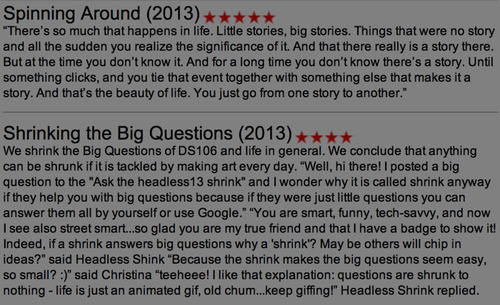
I answer this question with a little help from Photoshop and Hackssarus.
image

I worry about upsetting my team by giving us one less star, I worry about the other teams thinking I chose this show because I liked it, but that may be I did not like them as much. I worry about offending both teams I talk about here with some of my suggestions for improvement. It is hard to offer meaningful evaluation to others online, I find it easier to self-evaluate. But unless I hear external voices, I worry I am  in a digital echo chamber not learning new things just hearing what I want to hear.

What has helped the process is the closeness of our small group work and getting to know people. If we understand people’s motivation, it makes it easier to offer feedback that can be heard. Just because I want improvement feedback, and because DS106 announcements suggest we should learn how to evaluate ourselves and others effectively it does not mean that everyone involved in DS106 Headless 13 wants evaluation.

Some may just want a space make art and not a space to be evaluated. 

I need to tackle the issue of assessing others’ work.

  • How can criteria for assessment be agreed online?
  • How can we teach online participants to assess each other with rigour that comes out of engaging with the issue of setting clear standards?

Why? Selfishly, if I want to use this kind of model to support my own students then we need to be able to assess each other’s work to Masters standards and do so in a public setting. Self-managed learning offers a set of procedures that may help, but the group process and norm setting issues remain.

This feels an insurmountable challenge to introducing open education in my environment right now. I hope to learn more about effective ways to evaluate my own work and that of others as we move to the final (final?) stretch of this DS106 Headless. 
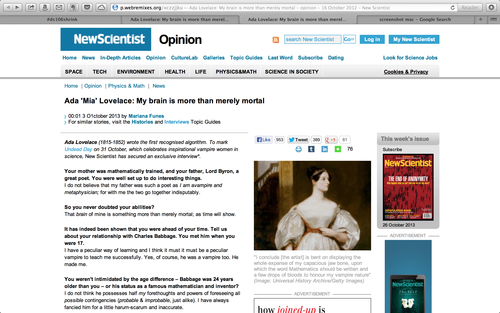
Breaking News

We follow our report on DS106 radio last night with evidence that Ada Lovelace did indeed give exclusive access to the New Scientist and confirmed she was turned in to a vampire by Babbage himself. 

image

You can read the full interview and confirm DS106 Radio’s sources online. If it is on the interwebz, then it must be true.

[Disclaimer – this is an assignment for DS106 Headless 13. All complaints should be addressed to  the comments section on their website]

Reflections and summary of week 9

It has been such fun to experiment with X-ray Goggles. I have learnt more about web page structure and have experimented with changing a few basic things on a web page to tell a story in one page. I was fascinated by this idea from Martha’s post – choices we make in content, design that enable us to tell a story in one page. In my case I only wanted to play with the content as I wanted it to seem that the content was from the original website and that it was a genuine interview. I was helped by the fact that the original webpage was a little tongue in cheek already. The piece was using original quotes from Lovelace writing to simulate an original interview. And with a title of ‘My brain is more than merely mortal’ – who could resist creating a Halloween story for our extra radio show?

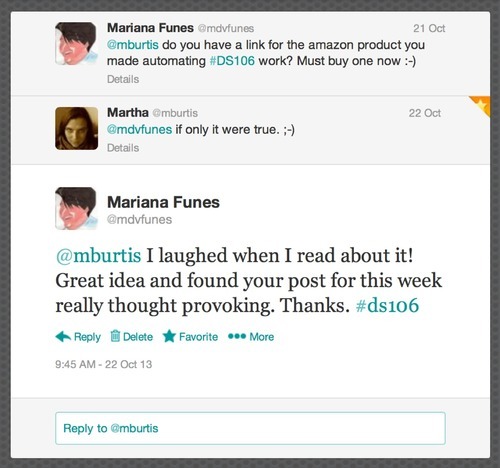
I was not familiar with the idea of using the web itself to tell stories. I loved some of the examples we learnt about, but my favourite one was the resume as an amazon product. In DS106, Martha’s idea of a machine that automated DS106 work tickled me but the page is no longer available and when asking her where I could buy one, alas I was dissapointed:

image

I loved this week. I (almost) managed to get all the requests on the weekly announcement done and more! Our @talkyteam managed a special Halloween edition of ‘DS106 Shrinking the big questions’ an assignment over and above the call of duty. Once again such a joy to work with this group of people. This time we were busy – we did not talk to each other on hangouts, we did it all asynch through G-docs and emails under the sterling direction of Karen ‘Bossy’ Young. For myself, I looked at the outline proposed by Karen, added ideas as I thought of them, and just made some art, Bub! Our editor had control over what was used on the final version of the show – I just had fun creating more audio artefacts.

I also have done my first live  radio broadcasts – a 3 hour marathon with John Johnston to premiere our original radio shows here in Europe, and a couple of test broadcasts with Alan Levine to enable me to headline our radio show live.

I did not complete the 5 comments with the fictional character on assorted blogs the announcement requested. I wanted to do Chatty Colin commenting on DS106 from a dog’s eyes. Or get Mia Culpa my depressed clever vampire to comment of what she saw produced on DS106 blogs. I just ran out of time and was more motivated to create more audio from weeks 7/8. 

I am likely to create more one page stories, but also I can use what I have learnt in this fun way to adapt pages I may need for my teaching. It was a lot easier than I expected….and I only wonder one thing: which data centre in the world stores all the pages Hackasaurus produces? Your webpage link appears as if by magic – I love that. And yes, I guess I should have downloaded the file and uploaded it to my own site, but life is too short and I really have no desire for complete recollection. I am now starting to reflect on this whole archiving idea – using the internet to give us the super-memory we do not have….but that is for another day.

‘Stealing’ from Phonar…again!

I stayed up and made notes on the SoundCloud!

A key takeaway for me is that you cannot produce the artefact unless you know the narrative and the characters – if you do not, how would you know what to photograph?

Here is the Storify with notes from other students. I like to get some clear input and not always have to create all learning experientially from scratch.I found this helpful to ground in realistic assessment the hype of making art. We need to do our research and critically assess the impact our work can have. 

The Decline of Wikipedia: Even As More People Than Ever Rely on It, Fewer People Create It | MIT Technology Review

Do not attempt if distracted – Shrinking the big questions

And if you want to make sense of this post you need to read my previous post and most importantly – have listened to the show!

I want to start winding down audio weeks 7 and 8 so that I can start week 9 of DS106. I am feeling quite overwhelmed – like one of those situations when I ask my students to fill in feedback forms too soon after a class.

I know that they need time to process, but sometimes I do not have the choice to let them reflect before feedback as I have to follow the procedures set up by the place I may be teaching in.

Nobody is asking me to follow procedure on DS106 Headless 13. I am asking myself to follow procedure – complete weeks 7 and 8 before you move on to week 9. The reality is I will not complete for weeks as the list of audio to dos grows. Some might say, I will never ‘complete’ as DS106 is #4life. The rhetoric being what it is, I like the feeling of getting to the end of the weekly announcement – done!

So, as my true friend Talky Tina might say, here we go.

My previous post offered highlights of the work I did and posted a link to our radio show which for me was the highlight. Here, I want to complete audio weeks by following procedure to the letter.

I want to offer a personal ‘reflection upon [my] contribution to the radio show and to [my] assessment of the group process’ as requested in the weekly announcement.

I will write a more theoretical assessment of group process and how I see the differences between my current practice when facilitating groups and teams and what I have learnt here elsewhere. Here I want to use the questions posed in the announcement as a way to start a personal reflection on what the making of my first radio show has meant to me. For once in my life, I will do as I am told. Mum would be proud. 

How did your group go about choosing a theme and organising itself?
The idea for the programme came to me early on when talking with Talky Tina and Christina Hendricks here on this blog. The three of us talked about the meaning of life, about why shrinks are called shrinks and Talky said:
“Well, hi there! I posted a big question to the “Ask the headless13 shrink” and I wonder why it is called shrink anyway if they help you with big questions/ because if they were just little questions you can answer them all by yourself or use Google.”
This is how the theme was chosen. I love Frasier’s talk show, and had the idea we might do a call-in show with Talky and me shrinking the big questions of life. This was early on in the Headless 13 and when we had to make our first radio bumpers, I made bumpers for a show that did not exist other than as a vague notion in my head. My favourite was the one I started this post with, but we did not use it in the end. 

When it came to forming groups, I posted what I knew about the idea on our shared google doc and suggested the idea for the show. I think I invited a few people I felt I knew a little better to join the group, some did and some did not. As time went on some people asked to join the group and we welcomed everyone. We had a last minute joiner to help out with one element of the show. The theme was jointly chosen by Tina, Christina and me. But it evolved as we talked about the show and we included more people in our group. 

The organising was also quite organic. For example, I got quite bored typing everyvbody’s twitter handles and sent a Tweet asking if it was possible to do something about this, I did not know enough about Twitter to work out how to get a team twitter handle. Christina saw it, created the @talkyteam account and told us what we needed to do (open a Tweetdeck column and follow @talkyteam) to have the tweets turn up on our stream. it worked so well. It helped the organising but also the sense of identity of us as a team. The rest was easy – hangouts to talk, google docs to create a shared outline and talk asynch, and my Dropbox with a TalkyTeam shared folder to store stuff. A lovely touch here came from Talky Tina. As the dropbox started to get full of stuff and very unorganised, I woke up one morning to find that our DS106 doll has a penchant for tidiness – she had created her own little TalkyTina sub-folder to put her recordings in. Clearly, I took her lead and swiftly tidied up the Dropbox creating a sub-folder for each of us and one for introduction and close materials. 

We were all really motivated to make the show and enjoying the process.

This showed in the process of organisation and theme selection. Karen Young said on the live premiere that one of the things that made it work in her view was that we allowed everyone to play to their strengths and contribute rather than try to force an idea through. She is right. Once we had the shell of the programme, the idea that we were going to shrink the big questions, we put all the information on the Google doc (such as questions the Headless Shrink had been asked, ideas for style, examples of podcasts or shows that we might emulate) and people took all this and shaped it to their own visions. There was no micro-management of content, within the constraints of time and overall theme, each person selected a ‘question’ and wrote their own script.

I loved Radio-lab, so I tried to shape my piece in that way. The Cooking Show was Karen’s idea and she used the philosophy and meaning of life idea to create her hilarious and nuanced segment. Christina decided to play at shrinking the philosopher’s biggest question (what is the meaning of life?) and created a really thoughtful piece to explore this question. Jess’s numerology was all Jess. She took the question ‘what is DS106 and why DS?’ which we had been asked anonymously when I pleaded for questions on Twitter, and made it her own. I remembered about the DS107 rebellion, asked Jim Groom and he not only directed us to News on the March but also recorded a Soundcloud for us to use. The script Jess came up with was hilarious and really appealed to the geek in me, as a Dr Who fan the notion that 106 lost Dr Who episodes had been found appealed to me hugely. As did the idea that her Galaxy phone would have the answers. Rhonda was asked by Karen to join in to be the second cook on the cooking show part of the show, she recorded her parts and was happy to work with what we had to help us get to the end. She was very gracious and supportive – getting a new group member half way through the process would not have been so easy had it been anybody else. 

Talky Tina deserves a paragraph all her own. She rocks! She attended hangouts, created her own hangouts and made art as she was waiting all on her own at a hangout she created whilst we were all talking elsewhere. She was in her travelling container most of the time and yet had a good enough signal to talk with us and produce impeccable recordings of anything we asked her to do. She was a true professional actor, as well as giving us really useful technical tips as we wrestled Audacity and GarageBand. Alan Levine asked at the premiere if we thought she was real. Well, Alan, I can only say that she is more real to me than many ‘real’ Ds106ers that are lacking in art and in completing weekly announcements. She knows her stuff, she helps her team mates, she never lets her ego get in the way of opening night, and she gives us inspirational art and tips to boot. What is not real about that? The effort that goes into making Talky Tina an integral part of DS106 is something I am full of admiration for and support in any way I can. She rocks! And i just realised I have been doing week 9 stuff all along in supporting the narrative around our beloved true friend Talky. 


What was the easiest/hardest part of working as a group?

The easiest was working with the people who formed the team, we all had a sense of shared responsibility and a genuine desire to make something good. We all did the best we could to put our egos to one side and be in service of the craft. It was a joy to see something beyond any initial idea I may have had emerge as we engaged openly and honestly. 

The hardest for me was the time difference. I felt at times excluded from conversations that went on as I slept. This ended up working in our favour as relationships matured because it meant that we never slept as a team. Jess and I got stuff done as others slept and Christina, Tina, Karen and Rhonda worked whilst we slept. Seamless work flow with Bossy Young sending us our tasks as deadlines approached and we loved her for that!

How did you decide upon your own contribution to the show — did you pick something in your comfort zone or did you decide to push yourself in a new direction?

It was all a new direction. I have never done audio or radio before DS106 and have had negative learning experiences working with groups of strangers over the web on study projects. I did not have high expectations and, if I am honest, I was dreading the group work. In fact the only person to drop out of the group early on, was one of the people I worked with on a previous online project that had not gone well – I wonder if she had concerns about putting herself in that type of learning situation again after our previous experience. On that project for the Open University we found ourselves the only two people having to work on a project not of our choosing for assessment on a Masters Module with no community or tutor support. That experience left me feeling negative about virtual group work – and reinforced a belief that effective team work requires face to face leadership. A view I have since changed. I did have to push myself hard in a new direction to stay open to what DS106 radio group work would bring. Christina helped a great deal, as she was so positive about her previous experience.  

How do you feel your show holds together as a whole? Do you feel like you achieved your goals in terms of the story your group set out to tell? 

Yes, we achieved our goals.

Our goals were emerging and not fixed, so it is hard to say we achieved anything. The show took shape and we were all part of it taking shape. My contribution was more the big picture, staying on the theme of shrinking big questions, and pulling together threads as I saw them emerge online. Others contributed attention to detail, yet others a sense of humour, interesting insights, and all contributed a willingness to engage and share.

My sense is that what holds the show together is Tina’s inquiry into the big questions we chose to shrink. Her interventions throughout and her opening and closing the show. The actual questions we chose could easily become shows in and of themselves – ‘Shrinking with cooking’ with Karen and Rhonda- domestic goddesses, ‘Tina and Christina shrink philosophy’, ‘Jess shrinks the 106 conspiracy’, and ‘This The Headless shrink, I’m listening…’ (apologies to Frasier). 

I would like to turn this question on its head and say that it is amazing that such disparate ideas held together at all. The glue was Talky Tina and the good faith with which we engaged in the process together. As far as the quality of the radio show outside our learning experience – I do not think it holds together at all outside the ongoing narrative of DS106. A martian (or a zombie?) coming to it would not make much sense of it. The whole show is just a story that makes sense in the context of DS106 Headless 13 and to those of us participating in it. For those outside, I fear,  it would be little more than in-jokes and a Talking Doll that asks too many questions. In comparing this with what others have done, I see that radio needs to be standalone to have wide appeal. I also see that each short section needs to be standalone as a listener’s attention span is short and goes back and forth. 

My intention was to create something that would make us smile and would embody the nature of DS106. Does the show do this? Yes, I think it does. What comes through is how openly we engaged, and how we have developed our relationships with each other and outside the DS106 community. We are already talking about the next Talky Team assignment and are considering a Zombie Radio Show or station for Twitter Vs Zombies next round. Karen puts it best – we keep listening to what we have done and laughing at our own jokes, we enjoy the output we have created. For myself, I keep listening and finding subtle links between segments that we never planned as a group but that we each felt responsible to include in order for the whole to hold together. If any one of us had wanted to run away with their own ego and forget about the show as a whole, these subtle connections between segments would not have been there and the show would have been much poorer as result.  

What do you think people will say about it?

I have collected a couple of Tweets from people about the show. There were many more but I am out of time (I wanted to collect them all and do a Storify with them, but not right now).

The overall sense I have about what people are saying is that it has a lot of ideas in it, a lot of jokes and witty lines that perhaps can most easily be understood by those who made the show and other DS106ers, some interesting ideas about stories and life and some damn good commercials.  

You’ve worked pretty intensively with audio now for several weeks of DS106 — describe what that process has been like. 

I never gave audio a thought. I was surprised to see it have such extensive billing on the syllabus. And was not particularly looking forward to it. The process has been one of discovery. I do not listen to radio or music for reasons beyond the scope of this post, so it was not as a listener that I had any interest. I started to get interested out of necessity and realised that there was something I enjoyed about voice and audio. The last few weeks have been like finding a treasure trove with amazing trinkets from another planet. I have a sense of a precious mystery, as I ask myself what makes audio work. I am learning from listening to DS106 Radio and now even listening to my local radio station and beginning to understand a new language. 

Have you changed your feeling towards audio?  

I had no feeling for audio before, I am learning to love it.

When you started with this section of the class, what did you think it would be like and how did the experience measure up?

I thought it would be a chore to complete, but that I might learn something new. I did not have any expectations beyond learning how to tell a story with audio. So the experience had low expectations to measure up against. It seems meaningless and cliched to say it has offered learning beyond my expectations. What I have gained and am still gaining is much more precious than that – I feel like I am visiting a new country, one I do not understand well but am fascinated by. It reminds me of how i felt when I went to Japan. I loved it, it felt very special but I was also so very aware that I did not understand it. A great gift. Now, I had better get on with my audio to do list and start working on week 9. 

For a web begun, god sends thread...

Thank you Seth, for this lovely saying.

I hope God will send me thread as I sit to write my 2 week reflection post again. I spent all morning putting it together and did not save my work. I have had the opportunity to connect with the ephemeral nature of the web and with the ill-will of a mind full of unmet expectations. No, Tumblr does not auto-save drafts. Just breathing and noticing my attachment to completion, as I start again and keep saving every sentence.

I start again with half an idea of how I may put this together with the time I have left before I need to move on to the next thing. Have a tantrum? Write a stinking letter to Tumblr and meet them up the stairs?

i will just get on with my reflections for weeks 7 and 8 and write them down for a second time – may be with fewer links and shorter than the previous version, but reflections anyway.

Key insights:

  • Daily creates help me get into the habit of making stuff but do not meet any real quality criteria. I have done many and most I have forgotten. They fulfil a need in the moment but have no permanence
  • Assignments give me more time to wok on something and get it to a standard I assess to be ‘good enough’ – I prefer to work this way
  • These last 2 weeks have taught me much and left much work in progress
  • The highlight of the 2 weeks has been the radio show and whilst you can listen to the show below, i will be writing about my learning from it separately as there is much both practical and theoretical I want to unpack from the project. 

Of all the daily creates these last two weeks I like this one best,

image

It was done in response to TDC643 draw the internet. I like it because it started as a screenshot of a film I made for the same daily create and it ended up as I played with photoshop as something that emerged – just like the web does each day we connect with it. 

As far as audio my favourite was the create I made up for myself visiting the Phonar course.

Of the assignments my favourites are 2:

Both challenged me in different ways, one expanded my mental models of the value of audio, the other helped me expand my technical skills using GarageBand and iMovie.

I said that these 2 weeks have left me in flux with work in progress, I have begun a web and I hope God will send thread in the shape of time to complete this work and start week 9 before the end of week 9!

Here is the list:

  • Pictures for your ears podcast – editing a joint effort between two hashtag classrooms: DS106 and Phonar. I have been inspired by my interviews so far and hope a regular slot on DS106 radio may emerge
  • ColinPods – i have started a new blog for audio photos. I love the idea and want to do many more
  • Talky Team’s radio project blog post here – my personal experience
  • Keep getting better at all the tools as I am still limited by my lack of skill in bringing about the ideas I imagine
  • A ‘serious’ blog post about team process and facilitation of virtual teams – this project experience has made me question much of the received wisdom I work from when I facilitate executive teams in the workplace
  • I want to do a podcast shrinking another big question ‘is DS106 addictive?’ I have asked another Headless13 participant if I can use a conversation we recorded a while back as a starting point

What is the most important practical tip I have learnt this week? You guessed it – save your [add your own expletive] drafts regularly. The biggest insight? I am learning to be less about explanation and more about imagination.

Copyright © 2026 DS106 on the couch

Theme by Anders Noren — Up ↑